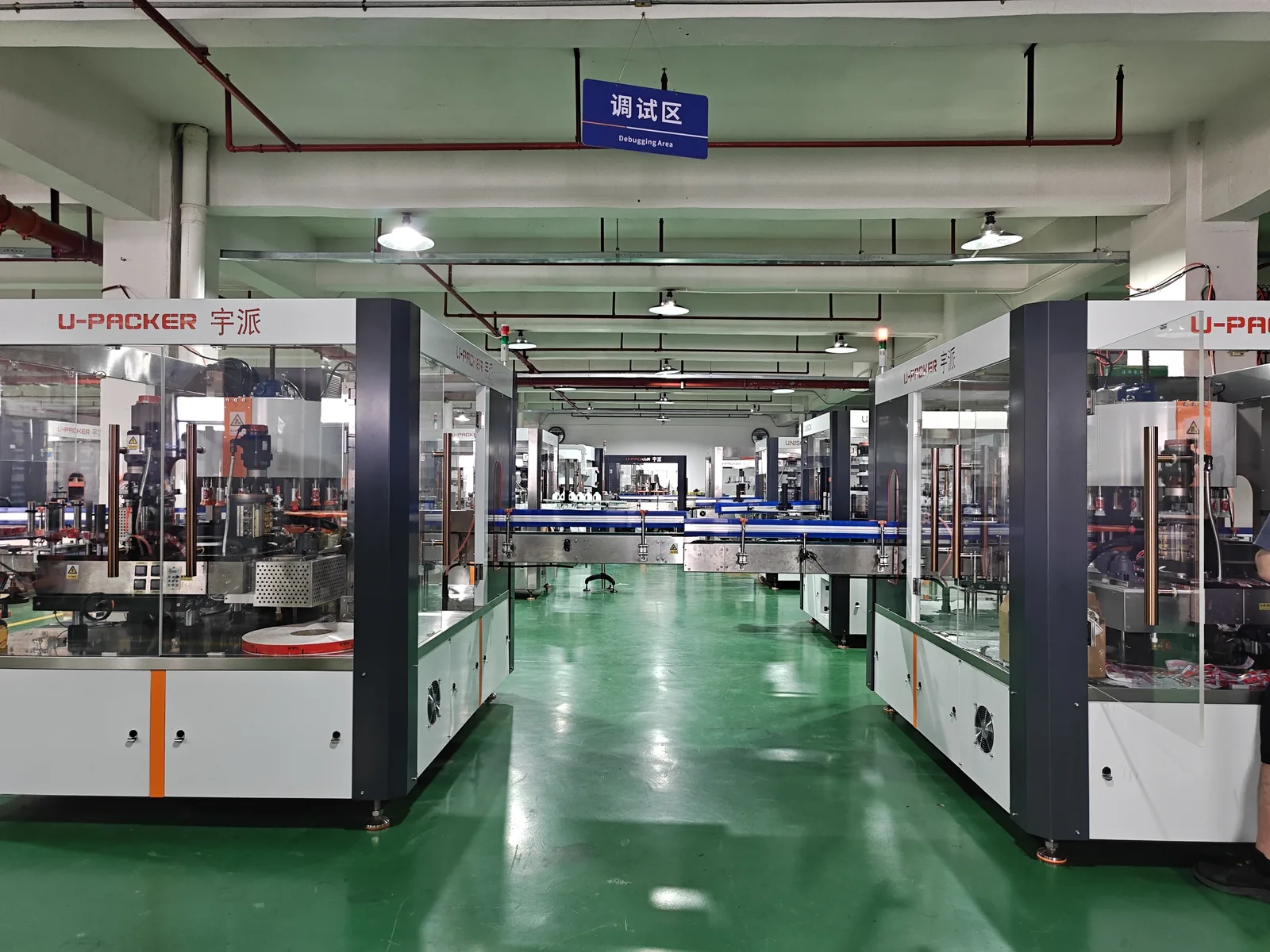
Applied is not applied correctly: why a vision inspection is needed after labeling
Labeling machine precision is specified in millimeters, and mainstream rotary machines achieve ±1mm. But precision describes the process ceiling of a well-tuned machine; in actual production, roll splices, bottle changeovers, glue temperature drift and conveyor vibration all let defects slip into the normal flow — missing labels, wrong labels, skew, wrinkles, bubbles. Most of these cannot be fully intercepted by the labeling machine's own label sensors, and manual sampling is limited by sample ratio and inspector fatigue.
The cost data makes the point: as reported by New Food Magazine, label errors were the single largest cause of US food recalls in 2024, with direct industry losses of about 1.92 billion US dollars for the year; in a survey by insurance broker WTW, 39% of respondents named "mislabelled product" among the main causes of recall. In China, a Class I recall must be initiated within 24 hours under the food recall rules — waiting for customer complaints is not a compliant strategy. That is why an in-line vision inspection after the labeling station is moving from an option on high-speed lines to a standard configuration.
What vision inspection checks: "present — straight — correct"
Looking at how mainstream international inspection systems organize their functions, label checks fall into three tiers — "present — straight — correct" — which map neatly onto three different kinds of risk.
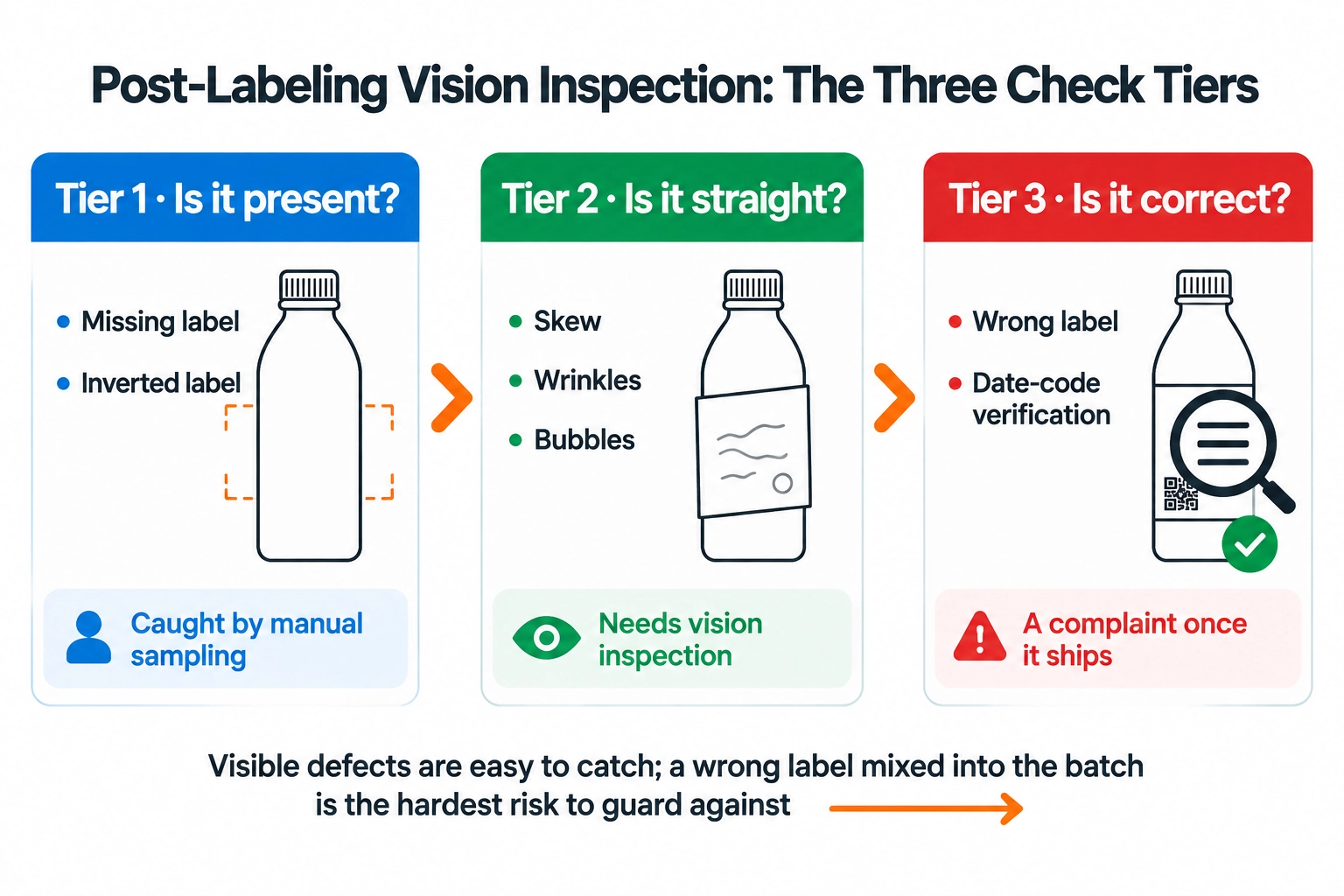
Tier 1, is it present: label presence and inversion — the most basic tier and the one no line can do without; a good design does not depend on label placement on the container, so no camera readjustment is needed after a label change.Tier 2, is it straight: label position and skew, flagging, wrinkles, bubbles, damage — defects that do not affect compliance but directly affect shelf image and brand perception.Tier 3, is it correct: artwork and logo comparison, barcode verification and character recognition confirm that "the label on the bottle is the one this batch should carry"; date and batch codes are checked for both presence and correctness. For exporters, tier 3 maps directly onto allergen labeling, batch and expiry regulatory elements — and it is precisely the item manual sampling covers worst. Across the last two international packaging trade fairs, the center of gravity has been shifting from tier 1 to tier 3: the recall cost of a wrong label or date code far exceeds a missing one — "applied" is no longer the pass standard, "applied correctly" is.
2D or 3D: choose the route by your defect cost structure
Two main routes implement these checks. 2D planar inspection images the label area with cameras and compares — simple, cost-controlled, and high-speed versions already support line rates around 100,000 bottles per hour. 3D curved-surface reconstruction uses multiple cameras to "flatten" the curved surface of a round bottle into one complete planar image before comparing, fixing 2D's structural blind spot: wrinkles, bubbles and micro-tears at the curved edges are easily missed in planar imaging but reliably detected once flattened. Deciding which route you need comes down to the defect cost structure: if cosmetic defects such as wrinkles and bubbles reaching consumers would cause real brand damage (personal care, cosmetics, premium beverages), 3D reconstruction is worth the investment; if the main risk is wrong labels and date codes, a 2D solution with the budget prioritized on tier-3 checks is the better deal.
AI solves a money problem: false rejects and changeover
After a vision system goes live, the two most common complaints are not "it cannot detect" but "it rejects good bottles" and "changeover is slow". False rejects are money thrown away: water droplets and foam on bottles look like real defects in the image, so conventional threshold algorithms err on the side of caution and fully good bottles get scrapped every shift; learning-based algorithms train on large sample sets to recognize such false defects, and leading vendors already quote false-reject rates at the 0.3% level. When evaluating a system, always ask for the test conditions behind the figure, and design a manual re-check station for rejected bottles. Changeover cost is often underestimated: when bottles or labels change, the time to recall camera parameters and templates and to re-calibrate directly affects efficiency on multi-product orders; leading systems call inspection recipes automatically and compress this from hours to minutes — on multi-product lines, that capability weighs as much as detection accuracy itself.
Data and regulation: how much value the system retains in three years
New-generation inspection software classifies defects automatically and links each class to its likely causes — a slow rise in the wrinkle ratio, for example, usually points to glue temperature or label-web tension drifting, and the system can warn before a bad batch is produced; once the inspection data is uploaded to the factory management system, it also connects with batch traceability and output statistics. In other words, a well-configured vision inspection not only intercepts defective bottles, it keeps telling the labeling machine "what is going wrong".
The other ongoing change comes from regulation: after the EU tethered-cap rules took effect, inspection vendors promptly launched cap-inspection modules — a reminder for exporters that an inspection solution must leave room for regulatory evolution rather than being configured once for today's needs. Meanwhile, a market for stand-alone inspection units "retrofittable behind any brand of labeling machine" has taken shape: retrofitting is flexible, but mechanical integration and timing matching are your own responsibility, and when a disputed defect appears, the labeler and the inspector are two separate parties — which is exactly the starting point of the U-Packer approach below.
Selection points for medium- and high-speed lines
For lines running 30,000 to 60,000 bottles per hour, we recommend deciding in this order:
- Rank inspection items by risk: compliance risks first (wrong labels, date and batch code errors — directly recall-related), brand risks second (wrinkles, out-of-tolerance skew), efficiency items last (missing labels, flagging). On a tight budget, get it correct first, then get it pretty.
- Leave timing headroom: the inspection unit's rated capacity should exceed the labeler's peak output by at least 20%, and that figure should be with all inspection items enabled — not with only presence detection on.
- Fix the technology route and changeover capability: choose between 2D and 3D by the defect cost structure; on multi-product lines, prefer systems with automatic recipe changeover.
- Ask about false-reject rate and data capability: the test conditions behind the figure, batch-level data retention, and connectivity to the factory management system decide the long-term value of the inspection.
The U-Packer solution: labeling and inspection integrated from the same source
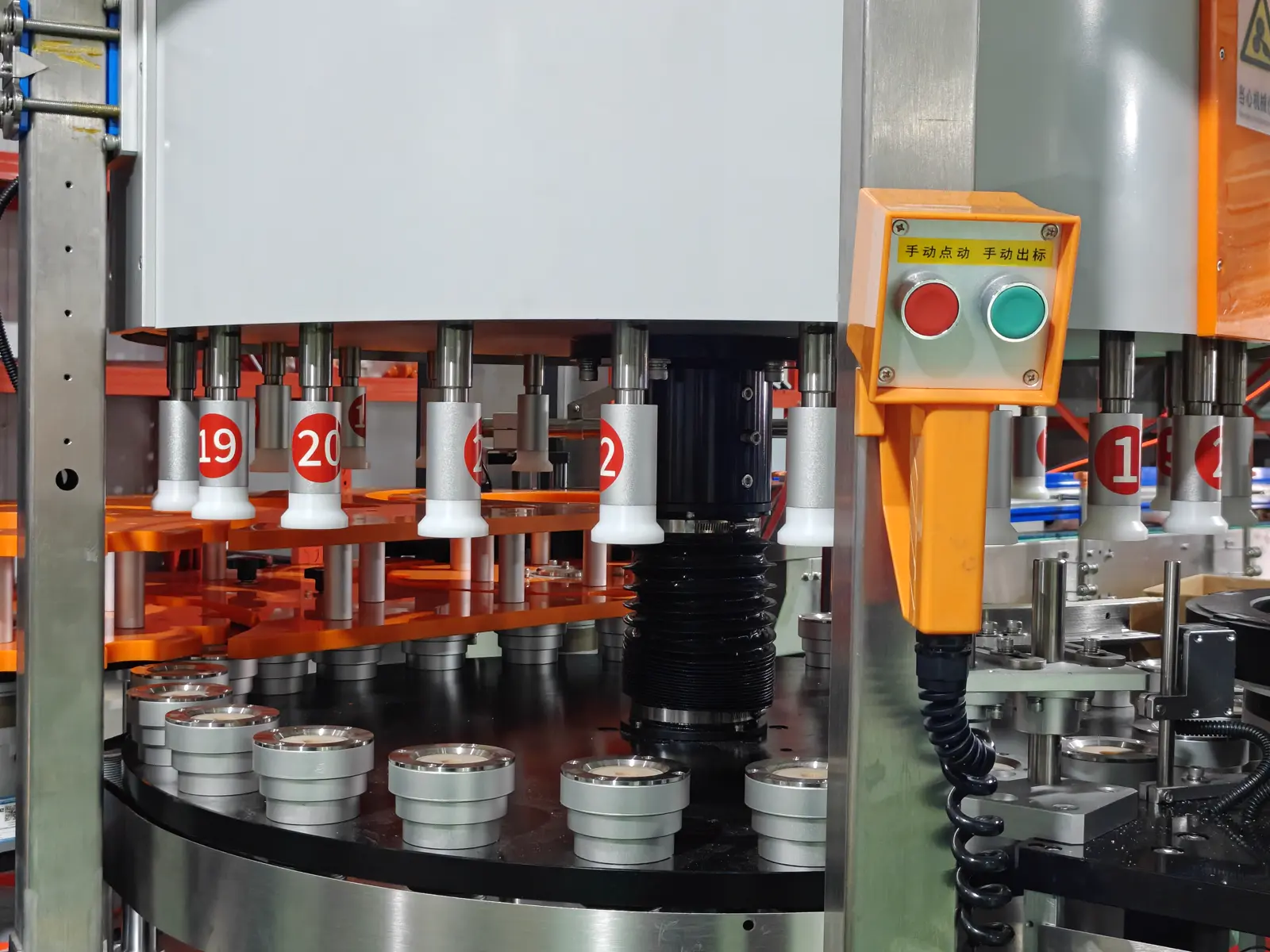
Faced with the two common routes — "inspection supplied by the labeler manufacturer" versus "third-party retrofit inspection" — U-Packer starts by closing the loop inside the labeling station itself. U-Packer's rotary platforms run from the electronic cam machines, whose proprietary servo system drives every station independently, up to the modular labeling machine at 58,000 bottles per hour — all holding ±1mm labeling precision under their own control systems. The post-labeling vision inspection configured on these platforms is integrated with the labeler from the same source — sharing bottle recipes and changeover parameters, with rejection, re-check and statistics completed in the same control cabinet, and inspection timing matched to labeling timing by one team.
This integration addresses the two most practical concerns of medium- and high-speed lines: the mechanical integration and timing-matching risk of retrofitting third-party inspection, and the boundary of responsibility when a disputed defect appears — the customer faces a single equipment supplier instead of interface coordination between two vendors. Inspection items follow the three tiers above and can be tailored to the risk structure of the line, from missing and wrong labels and out-of-tolerance skew to barcode and date-code verification; for existing lines already in production, customized retrofit solutions are available by bottle and label type. If you are planning a labeling line or evaluating an inspection retrofit, bring your bottles and labels for a live test — our engineers will advise on the inspection configuration and timing match.
This article was written by the U-Packer labeling technology team. Recall and industry figures are from public reports and surveys (New Food Magazine: 2024 US food recall statistics, WTW 2024 food and beverage recall survey); vendor technology trends are drawn from public information released at the drinktec and interpack trade fairs. Further reading: Labeling Equipment for Packaging Lines: Process Comparison, Selection and Maintenance and Maintenance and Troubleshooting Essentials for Labeling Equipment on Automated Packaging Lines.