Yes — label adhesive affects bottle recycling in three specific ways: it can contaminate PET flakes during the hot caustic wash, discolor the final recycled resin, or build up on recycling equipment and force costly shutdowns. The European PET Bottle Platform (EPBP) requires adhesives to release from PET in the wash at 60–80 °C, so the good news is that modern wash-off hot melt adhesives and OPP wrap-around labels are engineered to meet exactly that — keeping both your bottles recyclable and your line fast.
This guide explains what actually happens to your label adhesive inside a recycling plant, which label-and-adhesive combinations pass the industry's recyclability tests, and what it means for the labeling equipment you run today.
How Does Label Adhesive Affect the Bottle Recycling Process?
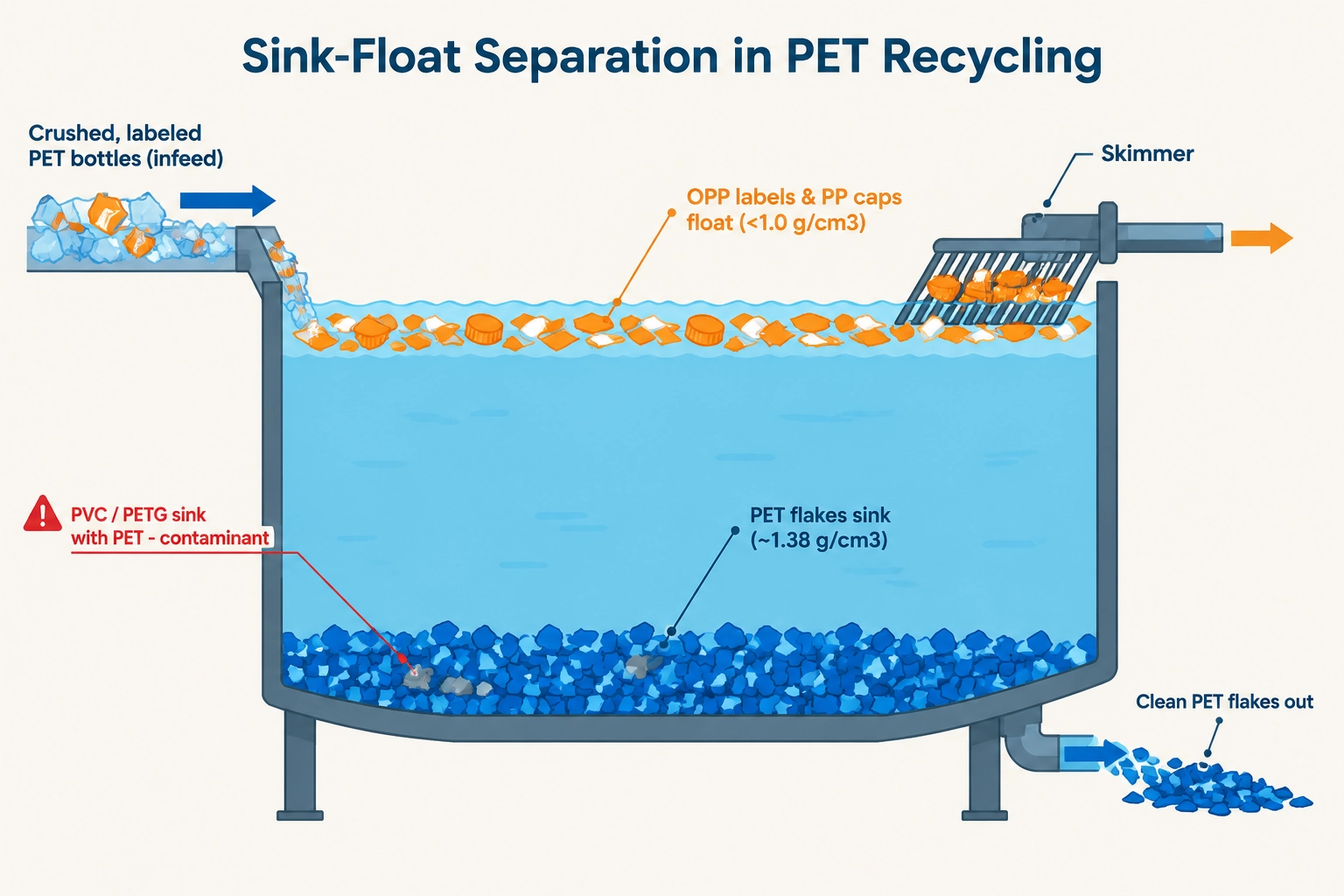
Inside a PET bottle recycling plant, your label and its adhesive meet three hostile processes: the bottles are ground into flakes, washed in a hot caustic system, and separated by density in a sink-float tank. A label adhesive that survives these stages intact becomes a contaminant; one designed to release becomes a solved problem.
The Association of Plastic Recyclers (APR) publishes the standard test protocols that simulate this exact journey, evaluating whether an adhesive separates from the PET flake, whether it stains or hazes the washed material, and whether it leaves tacky residue that fouls machinery. Adhesives that fail typically share one chemistry trait: they are neither water-dispersible nor designed to stay locked on the label substrate — so they migrate into the wash water and onto the PET itself.
The EPBP design guidelines set the pass/fail bar concretely: for a label on a PET bottle, the adhesive should be "non-dissolvable, non-detachable from label and fully releasable from PET in wash solution at 60–80 °C." As H.B. Fuller explains, "when adhesives fail to wash off or release, they contaminate the recycled material, reducing purity." The industry fix is the wash-off adhesive class — formulations that bond firmly on the bottling line yet release completely in the caustic wash, leaving the PET flake clean enough to return to food-grade applications.
Are OPP Labels Recyclable? The Answer Depends on Which System You Mean
OPP labels are technically recyclable — they are #5 polypropylene — but whether they get recycled depends entirely on the system handling them. In curbside programs, thin label films are rarely sorted, so an OPP label usually gets discarded. Inside an industrial PET bottle recycling line, however, OPP wrap-around labels are among the most recycling-friendly label options available, because they separate from the bottle automatically by density.
Here is why the industrial answer is different. PET flake has a density of about 1.38 g/cm³, so it sinks in the sink-float tank. Polyolefin label films — PE, PP, and OPP — all have a density below 1.0 g/cm³, so they float to the surface and are skimmed off along with the PP caps. The EPBP design guidelines draw the line at exactly this point: labels made of PE, PP, or OPP (all under 1.0 g/cm³) are the preferred, recycling-compatible choice, while materials denser than water — explicitly PVC, PS, PET, PETG, and PLA — are flagged as problematic because they sink together with the PET and contaminate the recyclate stream. The separation needs no manual label removal and no extra equipment.
| Label material | Density (g/cm³) | Sink-float behavior | PET recycling verdict (EPBP) |
|---|---|---|---|
| OPP / BOPP wrap-around film | <1.0 (polyolefin) | Floats — skimmed off | ✅ Preferred / recycling-compatible |
| PP caps & closures | <1.0 (polyolefin) | Floats — skimmed off | ✅ Recycling-compatible |
| PET bottle flake | ~1.38 | Sinks — the target material | ✅ The value stream |
| PVC shrink sleeve | >1.0 | Sinks — mixes with PET | ❌ Problematic contaminant |
| PETG shrink sleeve | >1.0 | Sinks — mixes with PET | ❌ Problematic contaminant |
This density advantage is one reason OPP hot melt wrap-around labeling remains the default choice for high-speed water and beverage bottles that brands want to certify as recyclable.
What Are Wash-Off Hot Melt Adhesives?
Wash-off hot melt adhesives are labeling adhesives engineered to release from the bottle in the recycling plant's hot caustic wash, while still delivering the instant, high-strength tack needed on high-speed lines. They give bottlers both: production-line performance and a clean, certifiable recycling story.
This is no longer theoretical — the chemistry has passed the industry's formal recyclability review. Henkel's Technomelt EM 598 RE, for example, is a pressure-sensitive hot melt whose alkali-dispersible formulation minimizes adhesive residue in the PET recycling system, and it carries APR Design® for Recyclability Recognition after passing the APR's PET-GC-02 test. When you specify a "recyclable bottle," it is precisely this kind of independently verified adhesive behavior that the APR and EPBP protocols are testing for.
A practical note for converters and bottlers: hot melt wrap-around labeling applies adhesive only in two narrow zones — a leading-edge dot and a trailing-edge seam — rather than as a full-coat layer. Less adhesive per label means less material to wash off, lower glue consumption per bottle, and a cleaner caustic bath downstream.
What Does This Mean for Your Labeling Line?
For the bottling line, the sustainability shift changes three things about labeling equipment: the glue system, the label materials it must handle, and the waste it generates. A modern hot melt OPP labeling machine addresses all three — which is why equipment choice is now part of the recyclability conversation, not just a speed-and-cost decision.
First, glue application. Wash-off hot melts need precise, temperature-stable application: too little glue and labels flag at 20,000+ bottles per hour; too much and you are spending money contaminating the wash bath. Look for machines with closed-loop glue temperature control and minimal-glue dot/seam application. Low-temperature hot melts also cut energy draw at the glue tank.
Second, waste elimination. A wrap-around OPP label has no release liner — the entire label goes onto the bottle, so there is zero liner waste on your floor. Compare this with pressure-sensitive (self-adhesive) labeling, which peels every label off a siliconized liner that then needs disposal. At 24,000 bph, liner waste adds up to tons of non-recyclable paper per line per year.
Third, material flexibility. Brands are trialing thinner OPP films, recycled-content films, and paper labels to hit ESG targets. Your labeling machine should handle this range without a rebuild — check film thickness tolerance and cut-and-stack accuracy before committing.
A word on the label-free trend: embossed or direct-printed bottles (the Evian and Coca-Cola UK trials) eliminate the label entirely, but they require new bottle molds, suit only very large single-SKU runs, and remove the flexibility private-label and export bottlers depend on. For the vast majority of beverage lines, a recyclable OPP label with a wash-off hot melt remains the pragmatic route to a certified-recyclable bottle.
Frequently Asked Questions
Can adhesive labels be recycled?
The label itself rarely gets recycled — but the right adhesive lets the bottle get recycled. A wash-off adhesive releases in the hot caustic wash, so the label film separates and the clean PET underneath returns to the value stream.
Do you have to remove labels from bottles before recycling?
Consumers generally do not need to remove labels — industrial recycling lines handle separation automatically. PET lines use sink-float tanks where OPP labels float and PET sinks, and the caustic wash dissolves compatible adhesives. Hard-to-remove full-shrink sleeves are the main exception.
Are OPP labels recyclable?
OPP labels are #5 polypropylene and technically recyclable, but curbside programs rarely sort thin films. In industrial PET bottle recycling, OPP wrap-around labels are recycling-friendly because they float in the sink-float tank and separate cleanly from the sinking PET flake.
Does hot melt glue affect recycling?
Standard hot melts can contaminate PET if they don't wash off, but wash-off hot melt adhesives are specifically engineered to release in the caustic wash. Because wrap-around labeling applies hot melt only at two seam dots, it uses far less adhesive per bottle than full-coat methods.
What is a wash-off adhesive?
A wash-off adhesive is a labeling adhesive formulated to bond firmly on the production line but dissolve or release in the recycling plant's hot caustic wash — the EPBP specifies release from PET at 60–80 °C — leaving the container clean for recycling. It is the adhesive class behind most certified-recyclable PET bottles.
Sources
- Association of Plastic Recyclers (APR) — PET recycling test protocols
- European PET Bottle Platform (EPBP) — Design for Recycling Guidelines
- H.B. Fuller — Adhesives and Recyclability: Why They Matter
- Henkel Adhesive Technologies — Technomelt adhesives (Technomelt EM 598 RE, APR Design® for Recyclability Recognition)
- Association of Plastic Recyclers (APR) — APR Design® for Recyclability Recognition
Guangzhou U-Pack Automation Equipment Co., Ltd. (U-Packer) builds rotary hot melt OPP labeling machines and self-adhesive labeling lines for beverage, food, and household-product bottlers. If you are evaluating a recyclable-label retrofit — from glue-system choice to film handling — talk to our engineering team or see our rotary OPP hot melt labeling machines.