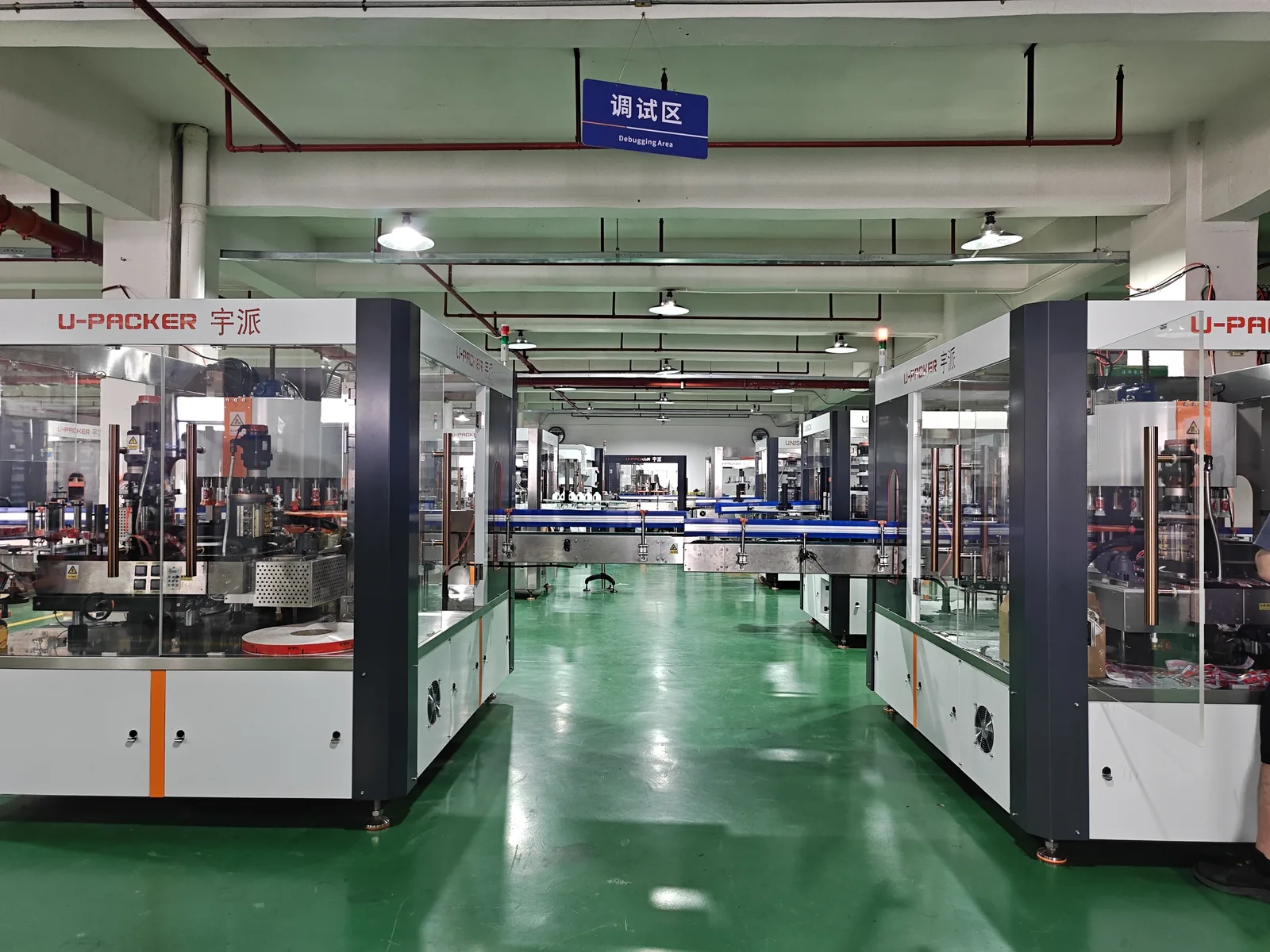
A hot melt labeling machine is a roll-fed labeler that wraps a cut band of OPP film or paper-plastic composite around the bottle and bonds it with hot glue applied only to the label's leading and trailing ends at 120-160 °C - no shrink tunnel, low glue consumption, and a full 360° printed surface. A self-adhesive labeling machine - also called a pressure sensitive labeler - peels die-cut labels that carry their own pre-coated adhesive off a backing roll and presses them onto the bottle with no glue, no heating and no drying. Both processes run on the same U-Packer rotary platform at ±1mm placement accuracy, from 1,200 bph entry machines to 58,000 bph modular lines, and the choice between them is not which machine is better but which label economics fit the line: roll-fed film typically costs 30-50% less per printed area than die-cut self-adhesive stock, while self-adhesive accepts any label shape - front, back, neck, contoured, promotional - without retooling. This guide compares the two processes factor by factor and names the machine classes each one leads to.
The two processes in one table
| Factor | Hot melt (roll-fed) | Self-adhesive (pressure sensitive) |
|---|---|---|
| Label material | OPP film, pearl film, paper-plastic composite on rolls | Die-cut labels on backing paper, adhesive pre-coated |
| Material cost per printed area | Lowest - typically 30-50% below die-cut stock | Higher - die-cutting and backing paper add cost |
| Label shapes | Full wrap-around bands; 360° print surface | Any die-cut shape: front, back, neck, contour, sticker |
| Glue system | Hot melt unit, 120-160 °C, glue on label ends only | None |
| Speed classes | 1,200-36,000 bph dedicated; 58,000 bph modular | 12,000-18,000 bph rotary; 58,000 bph modular |
| Bottle coverage | Round bottles (wrap-around), square via cam models | Round, square, oval, special-shaped - widest coverage |
| Changeover between SKUs | Roll and format change, minutes | Roll and format change, minutes |
| Energy and consumables | Glue consumption; no shrink tunnel | No glue, no heat; backing paper waste |
| Typical winners | Water, CSD, detergent at high volume | Food, daily chemical, craft beverage, multi-label bottles |
Label economics: the 30-50% gap that decides most lines
For the same printed area, roll-fed OPP film typically costs 30-50% less than die-cut self-adhesive stock, because die-cutting, backing paper and pre-coated adhesive all add conversion steps. On a 20,000 bph water line running two shifts, that gap compounds into the largest single cost difference between the two machine types - larger than the machine price difference within a year or two. This is why ultra-high-speed full-wrap lines - water, CSD, edible oil - stay on hot melt: at that volume the label is the product's second-largest packaging cost after the bottle itself.
The economics invert below a certain volume and label complexity. Short runs, seasonal artworks, front-plus-neck-plus-back combinations and contoured label shapes all carry premiums in film printing that they do not carry in die-cut digital or flexo short runs. Lines that cannot predict next year's label plan are usually safer starting self-adhesive and keeping the film option open - on U-Packer's modular platform both processes mount to the same frame later. Estimate the glue side of the hot melt equation with the hot melt glue cost calculator.
Speed and bottle coverage
Hot melt machines span the widest speed ladder: the single-station class labels 1,200 bph for small lines, the rotary dedicated class runs 6,000-36,000 bph, and modular hot melt configurations reach 58,000 bph. Self-adhesive rotary machines start effectively at 12,000-18,000 bph and scale through the same modular platform to 58,000 bph. In practice the process choice sets the entry speed: a line below roughly 10,000 bph that wants wrap-around film buys a small hot melt machine, while the same line wanting patch labels buys a self-adhesive machine and carries headroom.
Bottle geometry pushes the same decision. Wrap-around hot melt labeling needs a rotational surface - round bottles, or square and oval bottles on the cam models - while self-adhesive handles round, square, oval and special-shaped containers through matched fixtures, the widest bottle coverage of the two. Flat front-and-back labeling of square bottles, oval cosmetic-style bottles and heterogeneous shapes is self-adhesive territory; the full 360° billboard look on a round bottle is hot melt territory.
Operation, maintenance and changeover
A hot melt line adds a glue system: tanks and hoses held at 120-160 °C, nozzles that apply glue to the label ends only, and a periodic cleaning cycle. Modern end-only gluing keeps consumption low - the reason the process is called glue-saving - but the unit exists and needs maintenance. A self-adhesive line deletes that system entirely; its consumable is the backing paper left on the floor after the peel plate. Changeover discipline is similar on both: bottle fixtures, guides and a label roll swap in minutes, and electronic cam models recall stored parameter templates per SKU so repeat changeovers are a button press, not a re-setup. Print registration on both processes stays visible at full speed, and both hold ±1mm placement accuracy on the rotary platform.
When the answer is both
Plenty of plants run both processes - film wrap on the flagship SKU, die-cut patch labels on specialties - and for them the machine question becomes platform architecture. A dual-mode modular machine mounts hot melt and self-adhesive stations on one frame, sized to 58,000 bph, so the mix changes with the portfolio instead of the floor plan. If the line will stay single-process, the dedicated classes keep the cost down: the hot melt labeling hub covers the film process machine by machine, and the self-adhesive labeling hub does the same for pressure sensitive. A brewery-specific version of this comparison, sized to a 5,000 bph craft line, is in the beer bottle labeling machine guide.
Decision rule
Choose hot melt when one or two high-volume SKUs run all day on round bottles and the label is a full wrap: material savings of 30-50% per printed area arrive every hour the line runs. Choose self-adhesive when the portfolio has many SKUs, many label shapes or shaped bottles, and changeovers happen weekly. Choose the dual-mode modular platform when both are true, or when growth will make both true. Size the machine one class above the filler with the labeling capacity calculator, then verify the choice on your own bottles - U-Packer runs customer bottles and labels on the proposed machine before contract.
Frequently asked questions
Is hot melt cheaper than self-adhesive labeling?
On label material, yes: roll-fed OPP film typically costs 30-50% less per printed area than die-cut self-adhesive stock, and hot melt end-only gluing keeps glue consumption low. On the machine itself, dedicated hot melt and self-adhesive classes are quoted per configuration from around USD 50,000, so the material - not the machine - is the cost decision at volume. Below roughly 10,000 bph with complex label portfolios, self-adhesive's flexibility usually wins back its material premium.
Which process is faster?
Hot melt covers the widest ladder, from 1,200 bph single-station machines through 6,000-36,000 bph rotary classes to 58,000 bph modular configurations. Self-adhesive rotary machines run 12,000-18,000 bph and reach 58,000 bph on the same modular platform. At ultra-high speed both processes deliver; full-wrap lines above roughly 30,000 bph are predominantly hot melt for the film economics.
Can a self-adhesive machine do wrap-around labels?
Yes, within limits. Die-cut labels can wrap fully around smaller diameters, but a true 360° wrap on a large bottle at high speed is the hot melt process's home ground: continuous film bands, glue on the ends only, no die-cutting. Self-adhesive is the better fit when the "wrap" is a front label reaching around the corners, not a full band.
Do I need a shrink tunnel with hot melt labels?
No. Hot melt wrap labels use non-shrink OPP film or composite bonded at the overlap, so no heat shrink tunnel is required - that is one of the process's energy advantages over sleeve labeling. The glue unit itself runs at 120-160 °C.
Which bottles suit which process?
Round bottles run on both processes. Square and oval bottles run hot melt wrap labels on the cam models, and run self-adhesive patch labels through matched fixtures. Special-shaped and heterogeneous containers - flat panels, compound curves - are self-adhesive territory.
Can one machine run both label types?
Yes. Dual-mode modular machines mount hot melt and self-adhesive stations on one frame up to 58,000 bph, letting a plant migrate SKUs between film wrap and die-cut labels without buying a second labeler. Single-process lines stay on the dedicated classes, which cost less for the same headline speed.