Vet a Chinese labeling machine manufacturer like any capital-equipment partner: confirm it builds its own machines in its own workshop, check export credentials and certifications, test on your own bottles before paying the balance, and get every commercial term in writing. Five checks separate reliable manufacturers from resellers: a real factory you can visit in person or by live video; verifiable credentials such as ISO 9001:2015 and CE compliance; an export track record across dozens of countries with references you can call; engineering depth, meaning a machine family spanning 1,200 to 58,000 bottles per hour so the machine fits your line rather than the other way around; and transparent after-sales commitments covering warranty, spare parts and response times. We build rotary hot melt and self-adhesive labelers in Guangzhou and ship to more than 50 countries; this guide shows exactly how experienced buyers verify a labeling machine factory in China before signing.
What makes a reliable Chinese labeling machine manufacturer?
Four markers, in this order: real manufacturing, verifiable history, export volume, and in-house engineering.
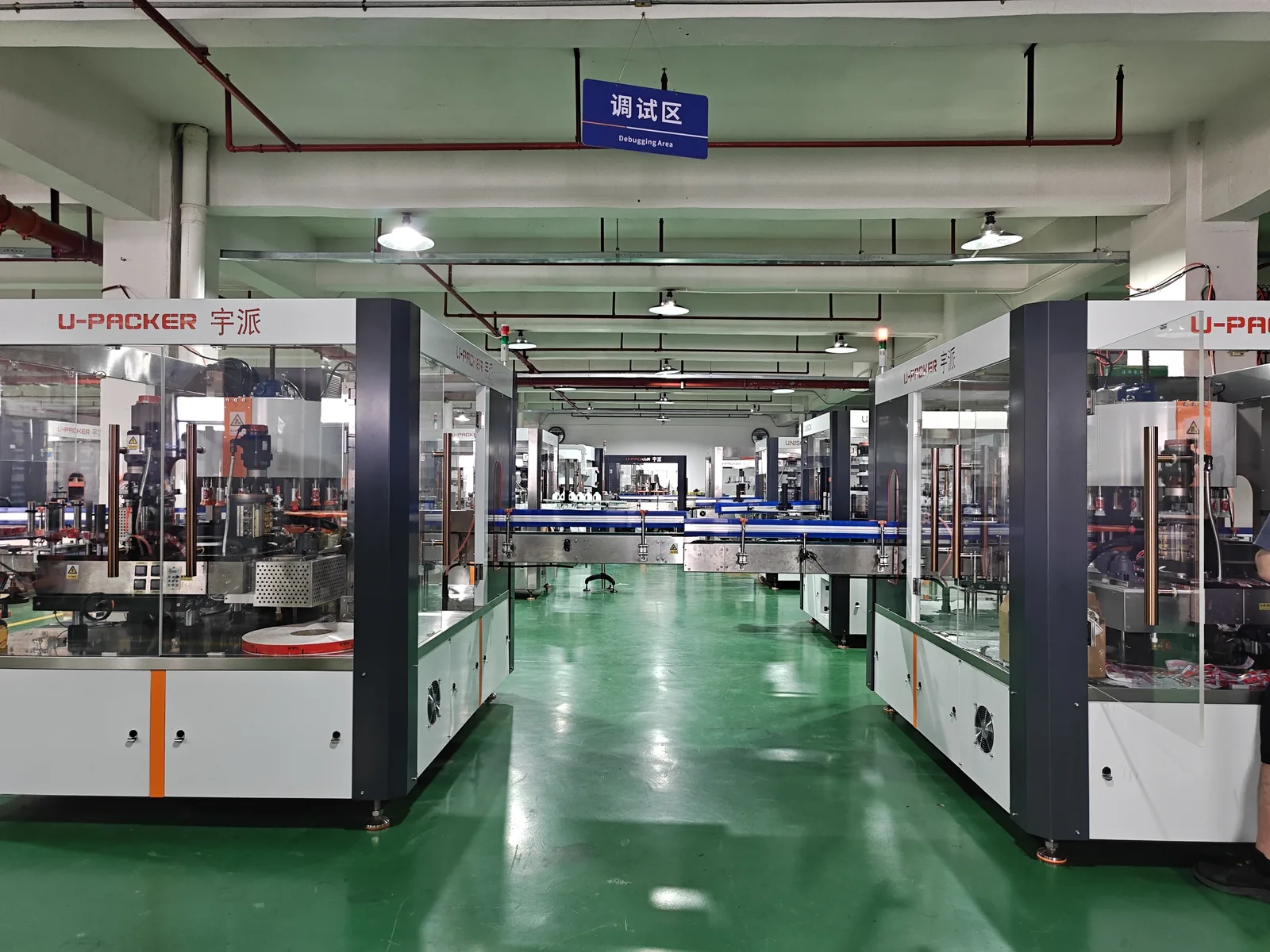
Real manufacturing. A manufacturer owns the drawings, machines the frames, and assembles, wires and tests every machine in its own workshop. A trading company resells whatever a workshop built for it this season — and in year three, when you need a spare gearbox or a parameter password, nobody remembers what is inside your machine. Our workshop in Guangzhou’s Zengcheng Economic and Technological Development Zone has been building automatic labeling equipment for more than 10 years.
Verifiable history and credentials. Look for an ISO 9001:2015 certificate whose scope covers labeling machine design and manufacture, CE compliance for machines bound for Europe, and granted patents on core mechanisms, not decorative registrations. Any credible supplier shows originals on request.
Export volume and engineering depth. Reliable manufacturers publish real case videos, name reference industries in your region, and run service points abroad — ours are in Jakarta and Kuala Lumpur. Engineering depth shows in the machine family itself: one machine at one speed forces your line to adapt; a family spanning entry-level to flagship rotary machines lets the recommendation adapt instead.
How do you verify a labeling machine factory in China?
Three levels of verification, cheapest to strongest: live video walkthrough, independent third-party inspection, in-person visit.
Live video walkthrough. Ask for a scheduled video call, then a second, unannounced one: have the camera pan across the assembly floor, open an electrical cabinet, and zoom into the machine tagged with your order number. A real factory can do this in minutes; a shell with a showroom album cannot.
Third-party inspection. Before shipment, commission an independent agency to witness the factory acceptance test, check nameplates against the contract and photograph the crating — trivial cost next to the machine value.
Visit in person. If you can, visit: half a day on the floor — frames, wiring, the test area running actual customer bottles, engineers facing unexpected questions — tells you more than any catalog.
Finally, verify every certificate with its issuing body: a CE number and an ISO 9001:2015 scope naming labeling machine design and manufacture are checkable facts. A supplier who hesitates to show originals has answered your question anyway.
How do you match machine type and capacity to your line?
Choose in this order: labeling process, bottle geometry, capacity class. Get the order wrong and you will comparison-shop machines that cannot do your job.
Process. Hot melt wrap-around labeling runs roll-fed OPP, pearl film and composite labels at the lowest label cost per bottle: glue only at the label ends, no shrink tunnel, and for the same printed area the stock typically costs 30–50% less than self-adhesive material. Our hot melt labeling machines cover this family. Self-adhesive labeling suits die-cut paper and plastic labels, front-and-back combinations and premium shelf presentation; see the self-adhesive labeling machines range. One line needing both label families? A modular combination machine mounts both processes in one frame.
Bottle geometry. Round bottles wrap cleanly on rotary machines; square and flat-panel bottles need dedicated stations to avoid wrinkles; oval and irregular shapes need custom bottle handling. The round bottle labeling machines family shows how widely geometry changes the configuration.
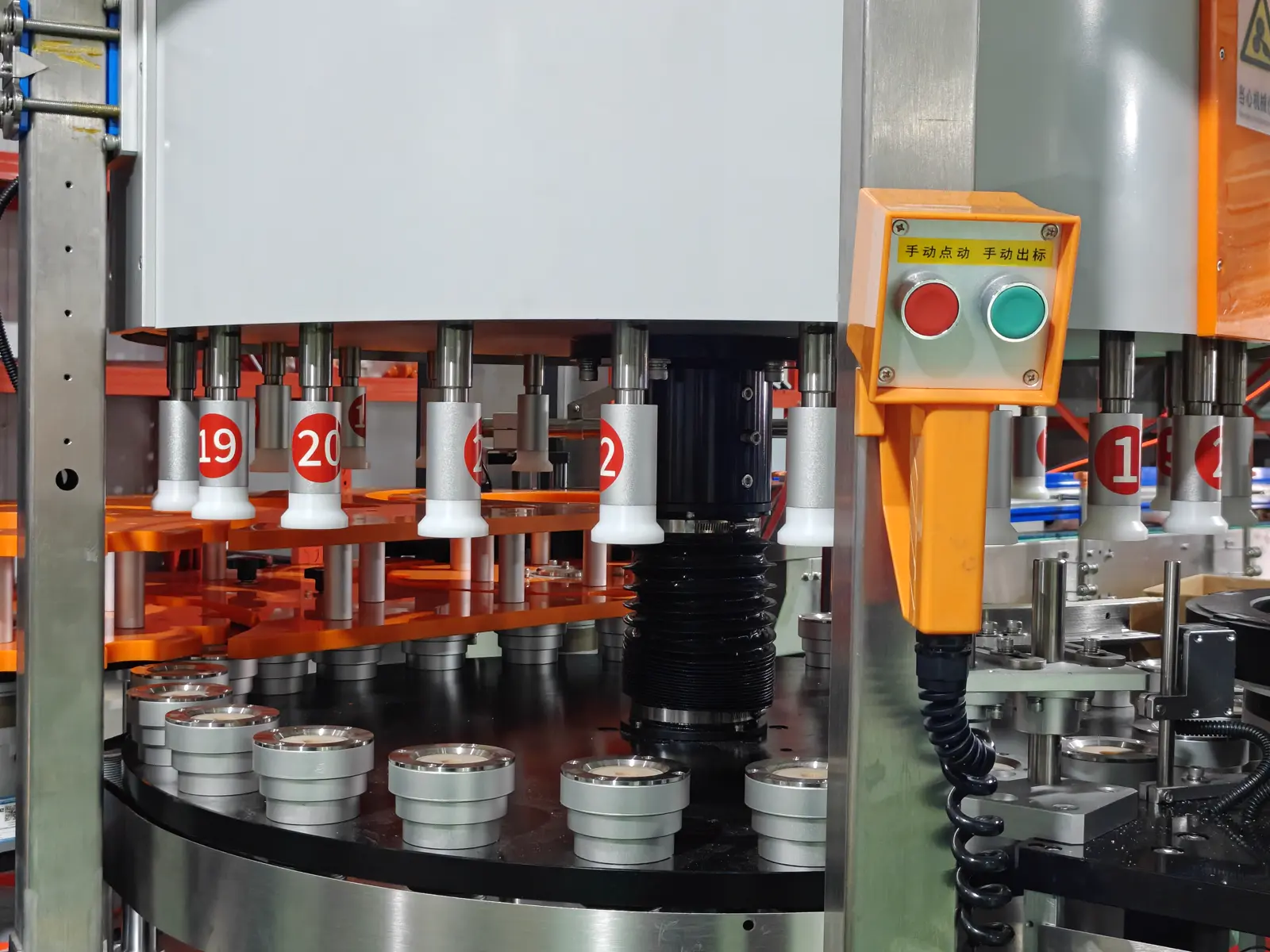
Capacity. The rotary ladder runs from a 1,200 bph single-station labeler through 4,000–7,200 bph cam machines to the 6,000–36,000 bph mid-capacity class covered by the rotary OPP hot melt labeling machine for round bottles, and up to flagship rotary lines at 58,000 bph. Large 5–20 L containers run at up to 3,500 bph on their own chassis. Rated accuracy is ±1 mm. Size the labeler above your fastest filler, not at it — labeling is the cheapest place in a line to hold speed headroom.
Why insist on sample runs, FAT and SAT?
A labeling result comes from three variables — bottle, label, machine — and at contract time you control only one. Test all three, in three steps.
Sample run before ordering. Send your bottles and labels, and ask for a video of them running on the proposed machine class; we run customer samples at the quoting stage, as does any manufacturer confident in its machines.
Factory acceptance test (FAT). Before the balance payment, the machine runs your containers at rated speed while you or your inspector watch — in person or by video. The parameter set that passes the test is stored on the machine and travels with it. Do not accept a FAT on the supplier’s demo bottles; mold seams, ovality and surface finish change everything.
Site acceptance test (SAT). After installation and commissioning on your floor, repeat the test with your production materials and sign an acceptance sheet. Operator training and the SAT protocol belong in the contract, not in goodwill.
What are typical prices, payment terms and lead times?
Price follows capacity class, process and changeover system: complete machines start at US$50,000 and vary with configuration — a single-station labeler at the low end, a flagship rotary line at the top.
The standard payment structure is a 30% T/T deposit with the 70% balance paid before shipment. Standard lead time is 30 days, with sea transit additional. If one quote lands dramatically below every comparable machine, assume the difference is inside the cabinet: unnamed gearboxes and drives, thinner frames, no redundancy on the stations that actually set accuracy. That is not a discount; it is a different machine wearing the same photo.
A trustworthy supplier puts payment milestones, lead time, warranty and spare-parts response in the contract — and treats written terms as normal, not offensive.
How do after-sales and spare parts work across borders?
Agree on four things before you need them: warranty scope, response time, spare parts logistics, and who pays for site visits.
Standard terms to expect: a 12-month warranty and a 24–48 hour response to spare-parts requests and technical questions. Ask precisely what the warranty covers — parts only, or parts and labor, or a technician’s travel — and get the answer in the contract. Order wear parts and critical spares with the machine, and require English electrical drawings, manuals and parameter records in the shipment.
Which red flags should end the conversation?
Any one of these is reason to stop, regardless of price:
No physical workshop. Only showroom photos or renders — and the same catalog images appearing under several supplier names on trade platforms.
Refusal of unannounced video. A scheduled tour is fine; the refusal of a second, spontaneous walkthrough of the assembly floor is not.
Specs without tolerances. Output speed quoted without the bottle it was measured on, or accuracy claimed without a ± value, is marketing copy, not engineering data.
Deposit pressure. Any push for a large deposit before a sample run or FAT date exists on paper.
Vague after-sales. No warranty duration, no spare-parts response commitment, nothing in writing — only reassurance.
Frequently asked questions
Are Chinese labeling machine manufacturers good quality?
Top-tier Chinese labeling machine manufacturers now export to more than 50 countries, build on CE and ISO 9001:2015 quality systems and hold patents on core mechanisms — the engineering gap with European builders has narrowed to specifics, not existence. Quality varies by company, so treat origin as a filter, not a verdict — verify factory, certificate scope and reference lines as described above.
How do I verify a Chinese labeling machine factory before ordering?
Demand a live video walkthrough of the assembly floor — including a second, unannounced call — and ask to see the machine carrying your order number; commission an independent inspection of the factory acceptance test; verify the CE number and ISO 9001:2015 scope with the issuing bodies. A real factory passes all three checks in days; a reseller fails the first one.
What capacities do Chinese labeling machine suppliers offer?
Chinese labeling machine suppliers cover the full ladder: entry single-station labelers from 1,200 bph, cam machines at 4,000–7,200 bph, the mid-capacity rotary class at 6,000–36,000 bph, and flagship rotary lines reaching 58,000 bph, with dedicated chassis for 5–20 L bottles at up to 3,500 bph. Choose process and bottle geometry first, then size the machine above your fastest filler.
How long does it take to get a labeling machine from China?
Standard production lead time is 30 days, plus sea transit. A supplier who will not write a fixed FAT date before the balance payment and a delivery window after it into the contract is telling you how the project will run.
Do Chinese labeling machine manufacturers support overseas after-sales?
Established ones do, in four layers: a 12-month warranty, a 24–48 hour response on spare parts and technical questions, remote video diagnosis for most faults, and regional service points or dispatched technicians — we run overseas teams in Jakarta and Kuala Lumpur. Judge the commitment by what the contract says, including who pays technician travel.
Working on a shortlist? Measure us against it: send your bottles and labels and we will run them on the machine class that fits your line, or book a live walkthrough of the Guangzhou workshop and question our engineers on camera — the same test we recommend for every manufacturer on your list.