±1 mm labeling accuracy — so why is the back label still crooked?
The same batch on the shelf: some back labels face the front label, others have wandered to the side; the splice of a wrap-around label sits on the bottle's mold seam and starts wrinkling and flagging after a few days; an oval bottle enters the labeling station sideways and the label lands on the edge — the bottle is scrapped. These three defects share one root: the angle the bottle happens to be turned to when it enters the machine.
The ±1 mm on a labeling machine's spec sheet describes the repeatability of placing a label at "a given spot" — but that spot needs a reference. A round bottle reaches the labeler through the conveyor at a completely random rotation angle. For single-label products where position doesn't matter, that's fine; the moment the back label must face the front or the label must avoid the mold seam, the random infeed angle becomes the direct source of defects. Manual bottle turning is neither realistic nor stable on a high-speed line — the machine has to clear this hurdle itself.
Vision positioning (container orientation in industry terms) exists to solve exactly this: before labeling, every bottle is first "turned into position". It pairs with post-labeling vision inspection as consecutive operations — positioning keeps position defects from happening, inspection keeps any escapees from flowing out (see Post-Labeling Vision Inspection Explained).
The principle in one sentence: find the specific point on the bottle and turn it to the right angle
The idea is not mysterious: a camera finds a specific point on the bottle's circumference — most typically the mold seam — and the bottle-holder servo turns the bottle to a defined angle, so the label lands at its intended position. The industry has moved from printing register marks and probing them with photoelectric sensors to today's mainstream approach of cameras recognizing the bottle's own natural features, but the direction has stayed the same: no manual turning — let the machine recognize the bottle itself.
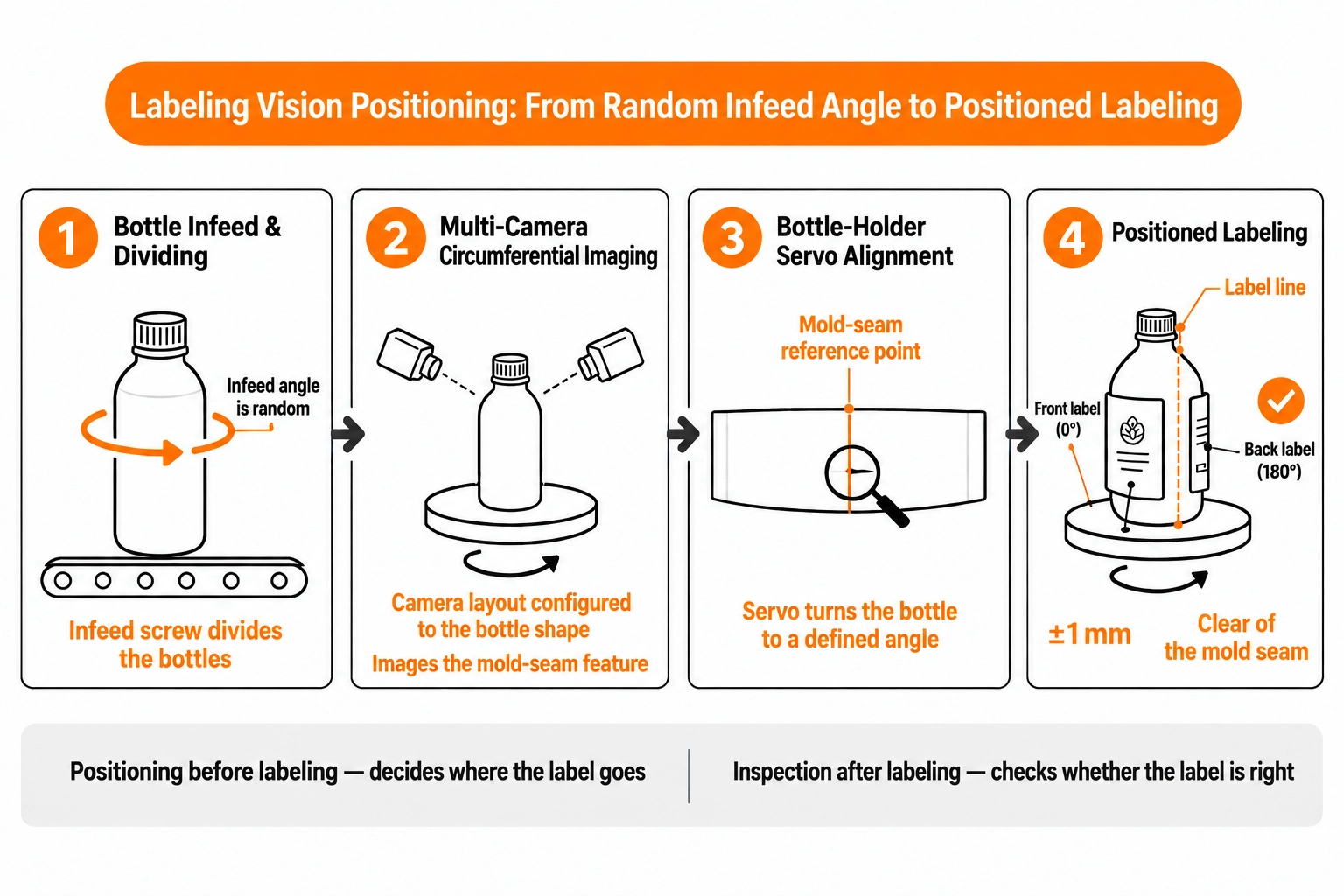
The payoffs come as a chain: once the bottle is turned into position, the front and back labels automatically hold 180°, the label clears the mold seam, and the wrap-around splice lands at its intended spot on the bottle's back; positioning accuracy after alignment is ±1 mm, the same order as the machine's labeling accuracy. The conditions for position defects are removed before labeling ever happens.
Does your line need vision positioning: one criterion
One question decides it: does the label position have a relative reference? These cases do, and are worth planning for: round bottles with front and back labels, where the back must face the front; glass and PET bottles that need seam avoidance or wrap-around splice registration; oval and square bottles that need an infeed attitude check; already-labeled containers receiving a second label that must register with the existing one. Conversely, single-label products with no position requirement don't need it — don't pay for it.
As for whether your bottle's seam or other features suit camera recognition — paper judgment is unreliable; the practical way is a sample test, covered below.
What U-Packer can do for you
U-Packer's vision positioning solution is configured on the electronic cam (FD) series platform. That platform carries one condition vital to positioning: every station is driven by its own servo motor, with the speed and rotation angle of the bottle holder directly motor-controlled — turning each bottle to its own angle is a native capability, so the execution basis for vision positioning requires no later modification. The camera configuration is customized to your bottle shape and feature position rather than one fixed layout; positioning accuracy after alignment is ±1 mm, guaranteed by the same control system as the machine's labeling accuracy; at changeover, positioning parameters are recalled together with the bottle recipe template, adding no changeover burden.
Vision positioning also combines with post-labeling vision inspection into a complete "positioning + inspection" scheme: positioning presses position defects down at the source, inspection catches the remainder at the outfeed — planned together, they close the loop on label quality. Lines already built on the electronic cam platform can evaluate the vision positioning retrofit directly.
How to start: send one sample and let the engineers give you the answer
Vision positioning is a "real-object" process — how well your bottle's features are recognized, and how the positioning scheme matches your line's cycle, cannot be settled on paper. Send your bottles and labels: U-Packer engineers will test feature recognition under laboratory conditions and give you concrete recommendations on positioning configuration and cycle matching, so the decision takes no detours. One sentence says it all: vision positioning answers "where the label goes", vision inspection answers "whether it went on right" — with both ends covered, your label quality is accounted for from shelf image to regulatory compliance.

This article was written by the U-Packer labeling technology team. Industry practice references are compiled from public trade information and from drinktec and interpack. Further reading: Post-Labeling Vision Inspection Explained, Round Bottle Labeling Machine Selection Guide.