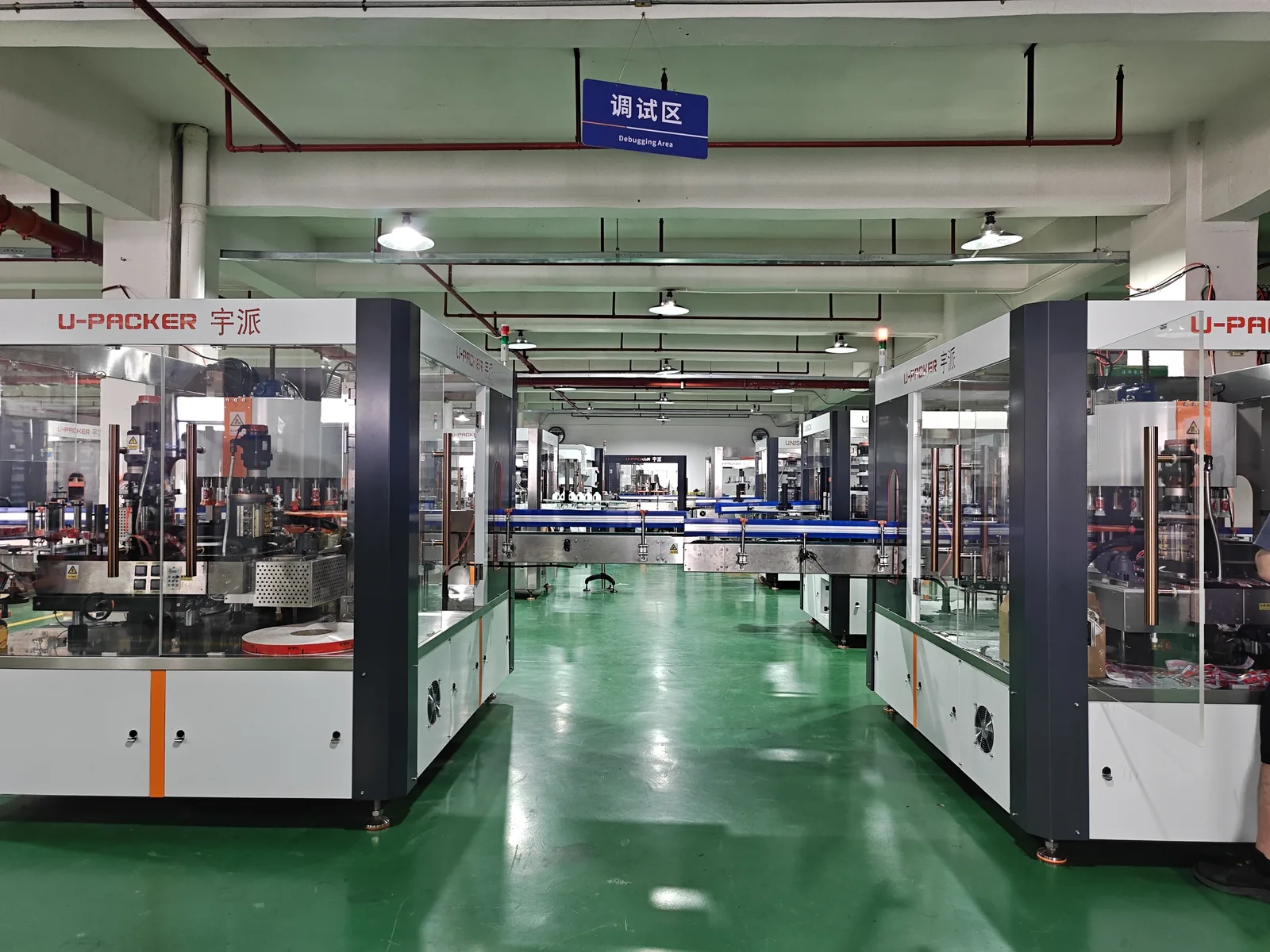
Question one: how many bottles per hour does this line run
When buying a round bottle labeling machine, the most common opening questions are "how much does it cost" and "which brand is best". But before comparing price and brand, there is a capacity question to answer: how many bottles does this filling line run per hour today, and how many in two years? Once the output bracket is fixed, the field of candidate machines shrinks by more than half; get the bracket wrong and every comparison that follows is out of focus. Too much capacity is idle capital — a 36,000 bph labeler behind an 8,000 bph filler will never turn surplus capacity into output. Too little means the line jams: the labeling station becomes the bottleneck, and every minute of stop-and-change piles bottles upstream.
Bracketing by output is therefore the most effective first step in selecting a round bottle labeling machine — and you can fix your own number in minutes: the labeling capacity calculator turns line speed or stations × rpm into real bottles-per-hour with efficiency losses, then matches the result against rotary models. Below, using real machine parameters from the U-Packer UHL series, we divide 1,200 to 58,000 bottles per hour into four brackets and walk through the lines each fits and the checks each requires.
Four output brackets: from single station to 32-station carousel
Output of a round bottle labeling machine is decided by two variables: the number of stations and the per-station cycle. Take the hot-melt round-bottle UHL-3632Y: 32 stations, 36,000 bottles per hour — about 1,125 bottles per station per hour. The 12-station UHL-1212Y in the same series runs 12,000 bph with the same per-station cycle of about 1,000 bottles an hour. More stations mean a lower per-station cycle: bottle separating, holding and label application all proceed more calmly, and precision holds better at high speed. That is why high output is usually met by adding stations rather than over-speeding a few of them.
| Output bracket | Representative machines (output/stations) | Typical lines |
| Entry about 1,200 bph |
Single-station labeling machine UHL-0101 | Small and medium capacity, new pilot lines, tight-footprint low-speed lines |
| Mid-low 6,000–12,000 bph |
Hot-melt 6–12 station UHL-0606Y / UHL-1212Y; self-adhesive 12-station UHL-1212 | Mid-size beverage and personal care plants, multi-variety mid-batch, frequent changeover |
| Workhorse 15,000–24,000 bph |
Hot-melt 16–20 station UHL-1516Y / UHL-1820Y / UHL-2420Y; self-adhesive UHL-1516 / UHL-1820 | High-speed water, juice and condiment main lines |
| High speed 36,000–58,000 bph |
32-station UHL-3632Y at 36,000 single machine; full-line configurations up to 58,000 bph | Mineral water, carbonated drinks and other bulk main filling lines |
A note on UHL model naming: in the hot-melt round-bottle and self-adhesive series, the first two digits roughly equal output in thousands of bottles per hour and the last two are the station count — UHL-1212Y is 12,000 bph with 12 stations, UHL-3632Y is 36,000 bph with 32. Learn the pattern and you can judge a machine's bracket at a glance, with any vendor (the electronic-cam FD series names differently and is another story).
Output alone is not enough: three checks that are easy to miss
First, label and bottle limit parameters. Every labeling machine has hard limits on label size and reel specs. For the UHL hot-melt round-bottle series: max label width 130 mm, max label length 600 mm, reel core diameter 152 mm, max reel outer diameter 600 mm. For full-wrap labeling, label length must match the bottle circumference plus an overlap allowance; extra-long or oversized labels need custom tooling assessment. The bottle & label size checker runs the four checks that matter — wrap-around label length, label-height clearance, taper limits and small-diameter handling — on your own container dimensions. Measure bottle diameter and height, label length/width and reel winding direction before asking for a quote — it saves rounds of confirmation.
Second, the test conditions behind rated output. Vendor ratings are measured on standard bottles with regular labels: the lighter the bottle, the longer the label and the heavier the condensation, the lower the cycle that actually holds stable. The practical rule is to size the labeling machine 15%–20% above the filling line's peak output to leave room for label changes, speed drift and long-term wear — and to ask the vendor to run the sample test on your hardest-to-label SKU, not the easiest one.
Third, accuracy retention at high speed. The ±1 mm on datasheets is repeat accuracy at normal speed. Two machines both rated ±1 mm can differ visibly between 60% load and full load; at acceptance, require a continuous run near target output rather than a low-speed demonstration only.
Hot-melt or self-adhesive: the process fork within the same bracket
Above roughly 12,000 bph, round-bottle lines usually choose between hot-melt roll-through and self-adhesive labeling. In short: hot-melt roll-through uses reel-fed labels such as OPP film, glues only the leading and trailing ends, keeps per-label material cost low, and runs glue at 120–160 °C — suited to high-speed lines with bulk output and few variants such as mineral water and beverages. Self-adhesive labeling needs no glue oven and changes labels fast, fitting multi-variety small batches and personal-care products, but its laminated liner structure pushes overall material cost about 30%–50% higher. Material utilization, maintenance cost and TCO for the two processes were analyzed in an earlier article — see Labeling Equipment for Packaging Lines: Process Comparison, Selection and Maintenance.
Square, oval and drums: branches beyond the round bottle
This guide focuses on round bottles. If your line runs mainly square or oval shaped bottles, look at the cam series instead: the electronic-cam labeling machine drives each station's speed and angle with an independent motor and recalls parameter templates at changeover — ideal for flexible multi-variety production; the mechanical-cam labeling machine is a mature, economical structure for single-format bulk continuous production. For 5 L–20 L drum round bottles there is a dedicated drum labeling machine. Finding the right product line by bottle shape beats forcing parameters on the wrong one.
After shortlisting: verify with one sample run
Once bracket and process route are settled, the last step is handing the decision to a physical test. Labeling is a physical-effect process: bottle surface finish, label adhesive and workshop temperature and humidity all affect application quality, and paper parameters cannot fully replace a real run. Complete a sample run before contract — send bottle samples and the actual label reels, have the vendor run continuously near target output, and watch repeat placement accuracy, overlap seam, glue amount and high-speed stability; keep the trial video as the acceptance baseline. Once labeling quality is settled, on-line verification of wrong labels and date codes can be planned as a vision inspection — see Post-Labeling Vision Inspection Explained.
To compress round bottle labeling machine selection into one sentence: fix output and headroom first, then check bottle and label limits, and finally verify with a sample run. If you are putting line parameters together, bring bottle drawings and label samples — U-Packer engineers will help set the station configuration and arrange the trial.
This article was written by the U-Packer labeling technology team. Output, station, accuracy and label-limit parameters are taken from the U-Packer UHL series product pages and are subject to actual configuration. Further reading: Working Principle of Self-Adhesive Labeling Machines, Maintenance and Troubleshooting Essentials for Labeling Equipment on Automated Packaging Lines.