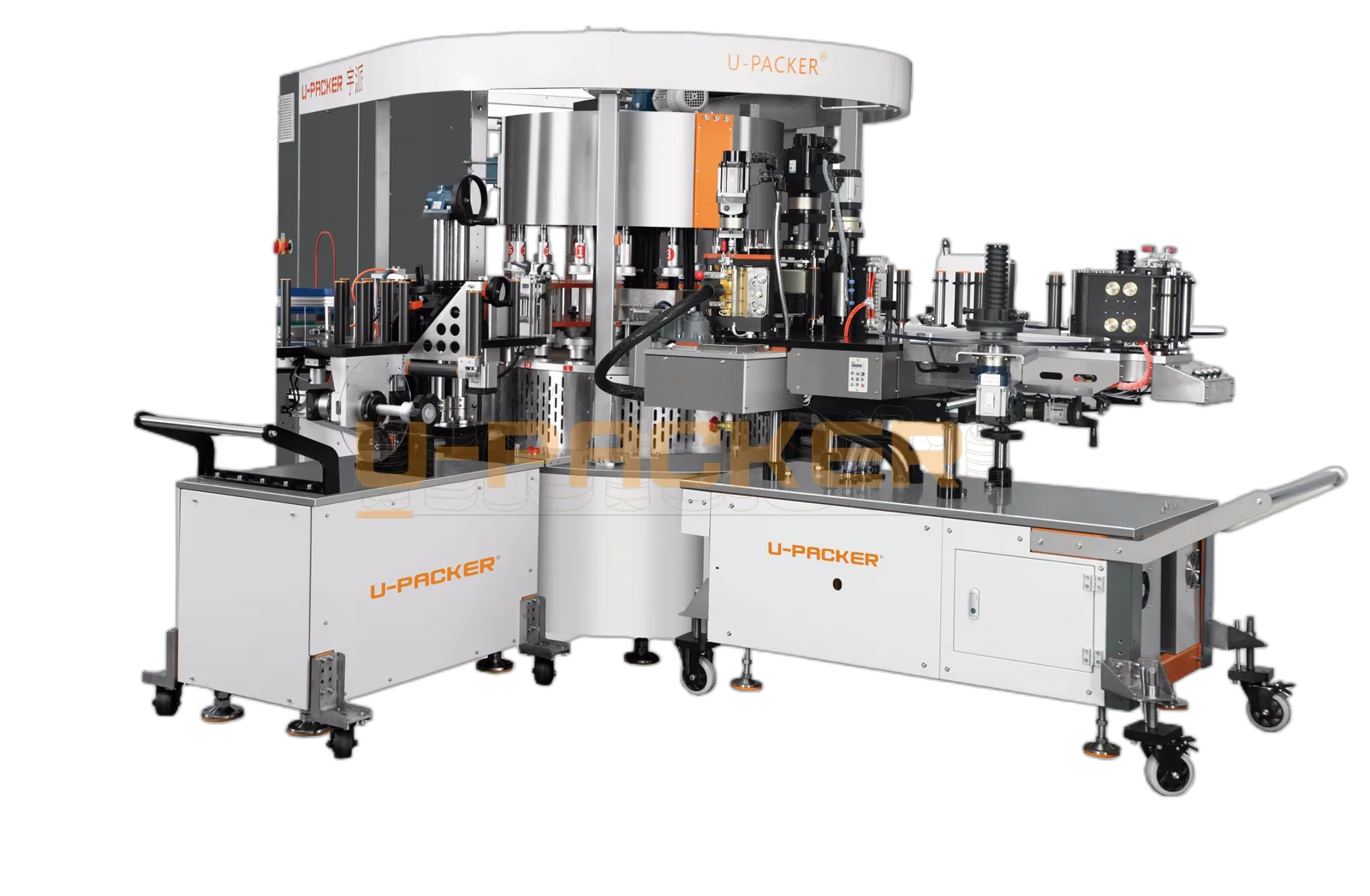
How much does a labeling machine cost? Market orientation, from configurations U-Packer builds and quotes: benchtop semi-automatic labelers occupy the USD 1,000-8,000 band; dedicated automatic rotary labelers - from a 1,200 bph single-station machine to 36,000 bph carousels - are engineered and quoted per configuration, with the class starting around USD 50,000; modular combination lines mixing hot melt and self-adhesive stations run from around USD 100,000 into the low hundreds of thousands at flagship speeds. No credible manufacturer publishes a fixed price list, because a labeling machine is configured engineering: stations, speed, bottle fixtures and label specification move the number more than the brand badge. The practical route is a six-point RFQ - bottle drawings, label artwork, target bottles per hour, container material, destination market and line layout - which returns an itemized quotation, usually within days. This guide walks the price bands, what each price includes, the cost drivers behind them, and how to read a quotation so that two offers can actually be compared.
Price bands by machine class
| Machine class | Typical speed | Market orientation band | What moves the number |
|---|---|---|---|
| Benchtop semi-automatic | ~900-1,800 bph (operator-paced) | USD 1,000-8,000 | Label width, dispensing mechanism, build quality |
| Entry automatic rotary (single-station) | 1,200 bph | From ~USD 50,000 | Format parts, glue unit, control package |
| Mid-range automatic rotary (cam machines, self-adhesive class) | 4,000-18,000 bph | Quoted per configuration | Station count, speed class, bottle fixtures |
| High-speed carousel | Up to 36,000 bph | Quoted per configuration | Station count, infeed integration |
| Modular combination line | Up to 58,000 bph | From ~USD 100,000 to low hundreds of thousands | Number and type of stations (hot melt / self-adhesive), controls |
Read the bands as orientation, not as a price list. The honest reason bands are wide at the top: a 58,000 bph dual-process line and a modest two-station modular line share a platform but not much else. For where each class fits your filler, the labeling capacity calculator converts filler output into the required class in one step.
What the machine price includes - and what it does not
A quotation from an established manufacturer normally prices the machine itself, format parts for your container range, the label applicator configuration and factory testing. Around the machine sit lines that buyers often discover late: conveyor interfaces and tables between filler and labeler; crating and inland freight to the port; sea freight and destination duties; commissioning - on site or by video - and operator training; and a first-year spares package. Ask for each of these as a separate line so two quotations can be compared line by line rather than by a single bottom number. Also ask what the FAT covers: at U-Packer every export machine is tested on the buyer's own bottles at rated speed before the balance payment, with video and photo report - a test that shifts the cost of discovering problems from your line to the factory.
The five drivers behind a labeling machine quotation
1. Process. Self-adhesive and hot melt wrap-around labelers are different machines; lines needing both can combine them in one modular frame, which is cheaper than two dedicated machines but is quoted as one engineered configuration. The material economics - roll-fed film typically 30-50% cheaper per printed area - are compared in the hot melt vs self-adhesive guide.
2. Speed class. Stations and frame size scale with bottles per hour. Sizing the labeler one class above the filler is standard practice; oversizing by two classes is money spent on headroom you will never use.
3. Bottle geometry. Round bottles wrap cleanly; square and flat bottles need dedicated stations; oval and irregular shapes need custom handling. The narrower your container range, the fewer format sets in the quotation.
4. Label specification. Label length and overlap on wrap-around lines, label pitch and unwind direction on self-adhesive lines - both change applicator settings and sometimes hardware. Verify feasibility before printing labels with the bottle label size checker.
5. Destination market. CE-compliant builds for Europe, voltage and convention matches elsewhere, and export crating are configuration items, not afterthoughts.
Machine price is the smaller half of the cost
Over a machine's life, label material usually outweighs the machine itself. A line labeling 10,000 bottles a day, 22 days a month, consumes 2.64 million labels a year; a few cents per label of material difference between die-cut self-adhesive stock and roll-fed film becomes a five-figure annual number - larger than the gap between machine classes. Run your own figures with the hot melt glue cost calculator before assuming the cheaper machine is the cheaper line. The other recurring lines are modest - glue consumption on hot melt units (applied only to label ends), electricity, wear parts and an annual service day - and a quotation should state spares pricing up front rather than leaving it to year two.
How to get an itemized quotation (the six-point RFQ)
A quotation is only as comparable as the inquiry behind it. Six points: (1) bottle drawings with diameter and height for every container; (2) label artwork with sizes, positions and - for wrap-around - label length and overlap; (3) target bottles per hour for your fastest filler, plus growth plans; (4) container material - plastic, glass or metal; (5) destination market and port; (6) line layout, so infeed and discharge interfaces are quoted, not guessed. With these six points, U-Packer returns an itemized quotation and, before contract, runs your bottles and labels on the proposed machine - the sample-run process described in the manufacturer selection guide. Machines are built by the U-Packer factory in Guangzhou; standard lead time is 30 days from confirmed configuration plus sea freight.
Frequently asked questions
How much does a labeling machine cost?
By class, as market orientation: benchtop semi-automatic labelers USD 1,000-8,000; dedicated automatic rotary labelers quoted per configuration from around USD 50,000; modular combination lines from around USD 100,000 into the low hundreds of thousands at flagship speed. The decisive variables are stations, speed class, bottle fixtures and label specification - which is why serious buyers exchange a six-point RFQ and compare itemized quotations instead of shopping a single number.
How much does an automatic labeling machine cost?
The automatic entry point is the 1,200 bph single-station rotary, quoted per configuration from around USD 50,000. Speed and stations scale the price from there: cam machines and the self-adhesive rotary class are quoted per configuration, the 36,000 bph carousel rises with station count, and modular lines mixing hot melt and self-adhesive stations start around USD 100,000. An automatic machine is configured engineering - name your bottles, labels and filler speed, and the quotation becomes itemized and comparable.
Where can I find a labeling machine price list?
You will not find a meaningful one, and be wary of anyone who publishes one. A labeling machine is built to your containers, labels and speed - a fixed list would have to be wrong for almost every buyer. What you can get in days is an itemized quotation: machine, format parts, applicator configuration, testing, conveyor interfaces, crating and freight as separate lines. That document is the real price list - for your line, not for an imaginary average one.
How do I get a labeling machine quotation?
Send six things: bottle drawings with dimensions for every container; label artwork with sizes and positions (label length and overlap for wrap-around); target bottles per hour for your fastest filler; container material; destination market and port; line layout. U-Packer returns an itemized quotation and - before any contract - runs your bottles and labels on the proposed machine class so the quotation reflects your real line, not catalog assumptions.
Is a cheaper semi-automatic machine the safer buy?
Only if the volume is genuinely small. A USD 1,000-8,000 benchtop machine fits hundreds of bottles a day and minute-by-minute SKU changes; above roughly 2,000 bottles per day the labor, consistency and upgrade-path math moves to the automatic entry rotary. The decision factors are worked through in the semi-automatic vs automatic labeling machine guide - including the crossover calculation on your own numbers.
What does a labeling machine cost per year to run?
Beyond the purchase: label material - usually the largest line over the machine's life, and the place where the 30-50% per-area gap between self-adhesive stock and roll-fed film lands; glue on hot melt units, applied only to label ends so consumption stays low; electricity; wear parts; and an annual service day. Ask for spares pricing and warranty terms in the quotation itself - a manufacturer confident in the machine puts them in writing at purchase time.