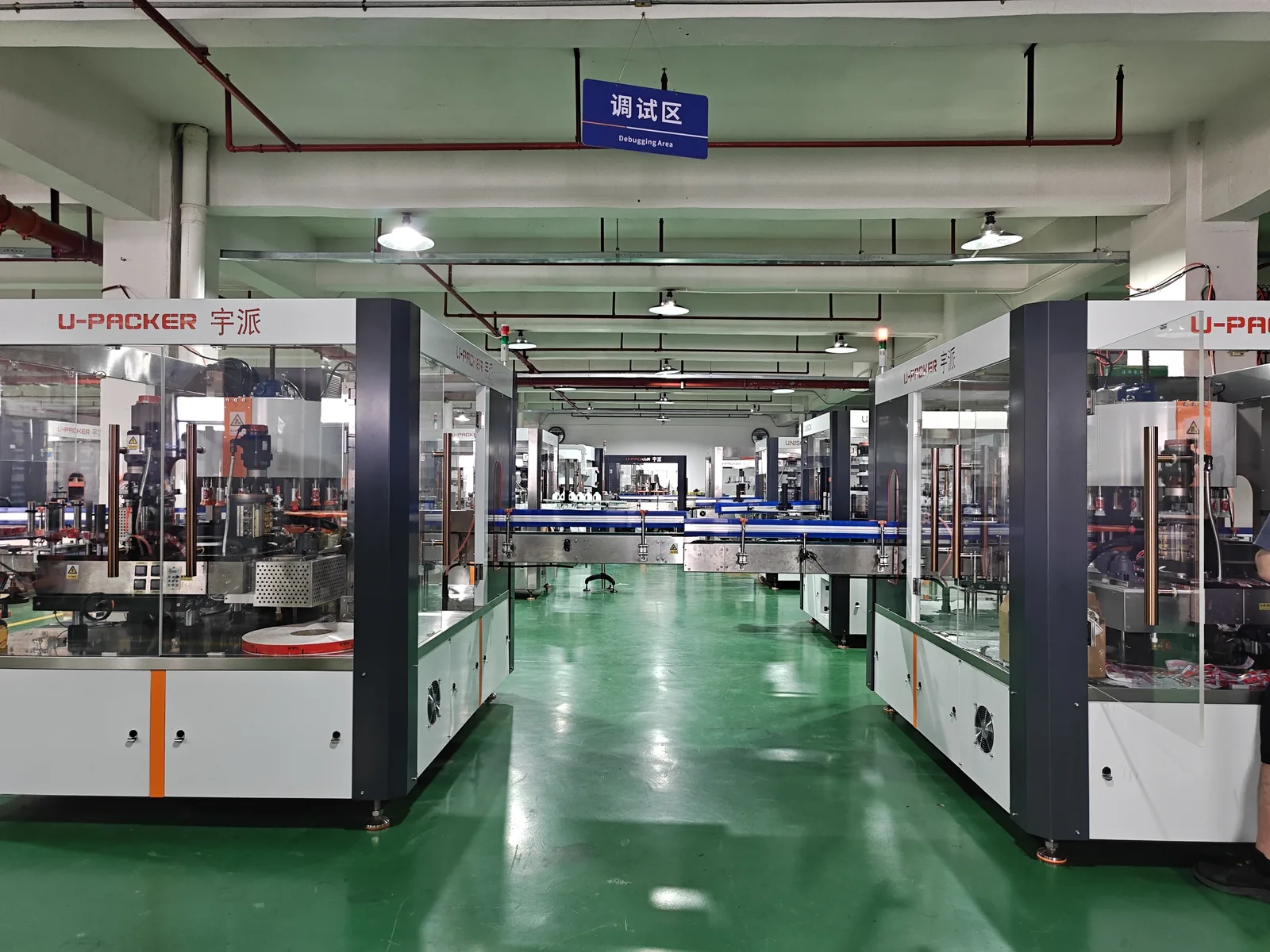
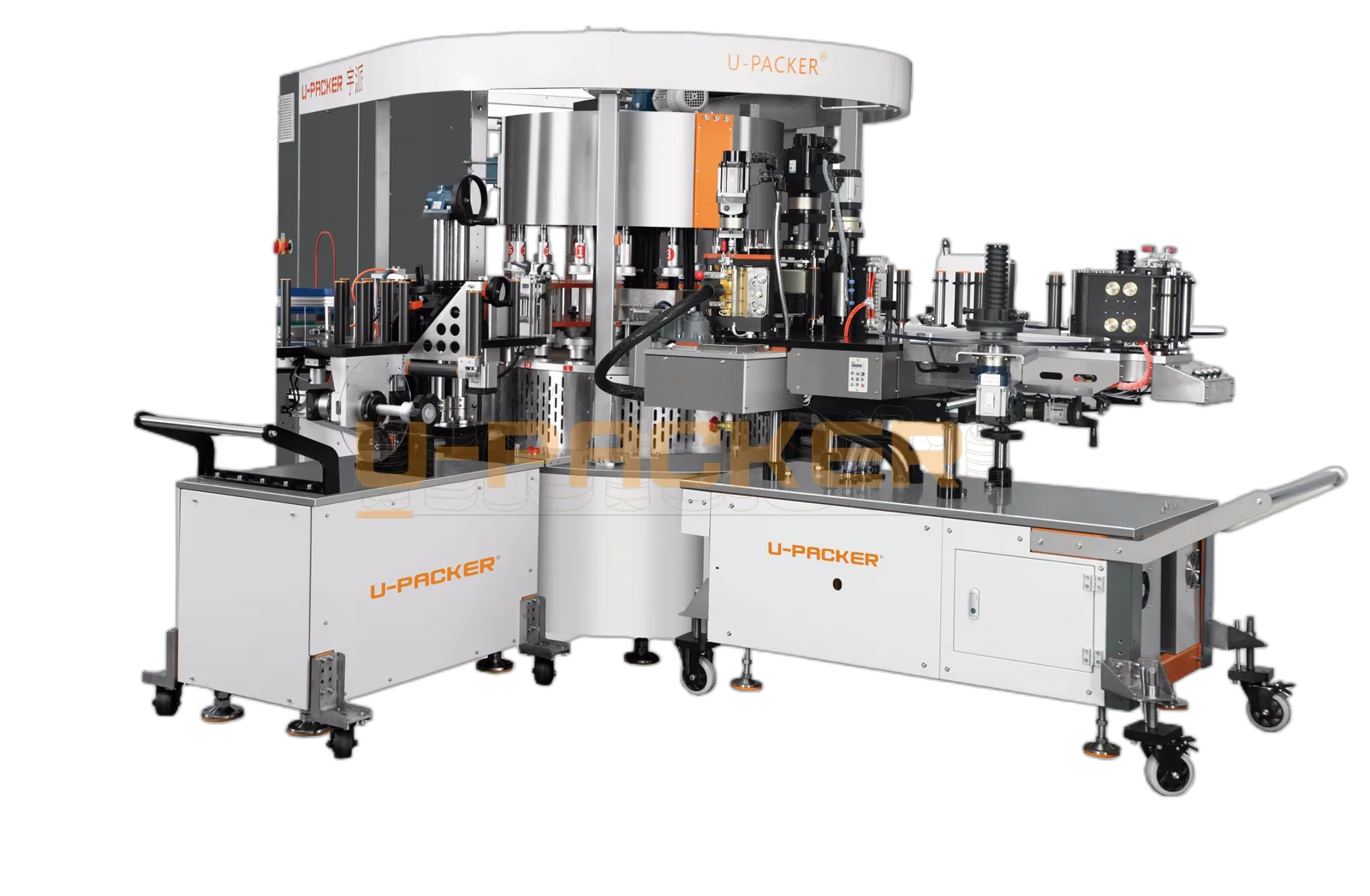
A semi-automatic labeling machine is a compact labeler in which the operator places each bottle in a fixture by hand and triggers label application - by foot pedal or sensor - while the machine feeds, applies and presses the label; a typical benchtop unit labels 15-30 bottles per minute with one operator and costs a few thousand US dollars. An automatic labeling machine feeds bottles from the production line by conveyor, screw and starwheel, registers each bottle without operator action and applies labels at line speed - U-Packer's automatic rotary family runs from 1,200 to 58,000 bottles per hour at ±1mm placement accuracy. The semi automatic vs automatic labeling machine decision comes down to three variables: daily volume per SKU, labor cost where the line runs, and how consistent label placement must be. Below ~2,000 bottles per day of frequently changing SKUs, semi-automatic wins; above ~15,000 bottles per day, automatic wins on every metric; between them, the crossover math - worked through below - usually lands in favor of the smallest automatic rotary machine.
What each machine class actually does
Semi-automatic. The operator is the feed system: bottle in, label applied, bottle out, repeat. The machine handles label dispensing and application only. Changeover between SKUs is quick because there is little automation to reconfigure, and the machines are cheap, small and movable. The costs hide elsewhere: placement depends on how consistently the operator loads the fixture, throughput depends on the operator's pace, and one operator tied to the machine is one operator not doing anything else.
Automatic. The machine is the feed system. Bottles arrive from the filler or an infeed table, an infeed screw spaces them, a starwheel or carousel presents each one, and labels are applied at rated speed with no operator in the loop. Placement accuracy is a machine property - ±1mm on U-Packer rotaries - not an operator property. The trade-offs are price, floor space and the discipline of keeping the bottle infeed running.
Nine decision factors, side by side
| Factor | Semi-automatic | Automatic (rotary) |
|---|---|---|
| Output | ~900-1,800 bph, operator-limited | 1,200-58,000 bph, line-rated |
| Operators per machine | 1 dedicated | 0 dedicated (line supervision) |
| Placement accuracy | Operator-dependent, varies through the shift | Machine property, ±1mm held all shift |
| SKU changeover | Minutes, mostly fixture and roll | Minutes on format-change rotaries; electronic cam models store per-SKU recipes |
| Floor space | Benchtop | In-line footprint with conveyor interface |
| Machine price (market orientation) | USD ~1,000-8,000 | Dedicated rotary machines from ~USD 50,000; modular lines from ~USD 100,000 |
| Label material | Mostly self-adhesive rolls | Self-adhesive or hot melt wrap-around film |
| Integration with filler | None - batch operation | Direct conveyor coupling, rated above filler speed |
| Scalability | None - add more machines and operators | Machine family spans 1,200-58,000 bph on one upgrade path |
Two rows deserve emphasis. Label material: semi-automatic machines are built around self-adhesive rolls, so a line planning full-body film labels for cost reasons - roll-fed OPP film typically runs 30-50% cheaper per printed area - is already pointing at automatic hot melt wrap-around equipment (see the hot melt vs self-adhesive comparison). And price should be read against the machine family, not the sticker: the labeling machine price guide explains why automatic machines are quoted per configuration and what drives the number.
The crossover math: when automatic pays back
Take a plant running one shift, 22 days a month, labeling 8,000 bottles per day of two SKUs, with fully loaded operator cost of USD 3 per hour (a mid-range Asian plant; a US or EU plant multiplies this several times over).
- Semi-automatic at 20 bottles per minute: 8,000 bottles occupies one operator for ~6.7 hours a day - about USD 440 per month in direct labeling labor, plus a second machine (and operator) whenever output peaks.
- Automatic rotary at 1,200 bph: the same 8,000 bottles take ~6.7 machine-hours with no dedicated operator - the operator cost moves to line supervision shared with the filler, and placement stays at ±1mm for all 6.7 hours.
At this scale the machine price difference is repaid by labor and consistency within roughly two to three years in the Asian example - and within months in high-wage markets. The calculation shifts back toward semi-automatic when daily volume is genuinely small (a few hundred bottles), when SKUs change every few minutes, or when the product runs in a workshop without conveyor infrastructure. As a rule of thumb: below ~2,000 bottles per day with frequent changeovers, stay semi-automatic; above ~15,000 per day, automatic wins outright; between the two, run the math above on your own numbers.
The automatic entry point is lower than most buyers expect
"Automatic" does not have to mean a 36,000 bph carousel. The single-station rotary labeler runs 1,200 bottles per hour at ±1mm - enough to label tomorrow's production in a fraction of today's manual time - in a compact footprint beside a small filler. It uses the same hot melt end-gluing process and the same format-part logic as the large rotaries, so bottles, labels and skills carry forward when the line grows into the 4,000-7,200 bph cam machines and beyond. Most labels applied by semi-automatic benchtop units are self-adhesive; the equivalent automatic process is covered by the self-adhesive labeling machine series, whose rotary class runs 12,000-18,000 bph.
Match the class to your filler rather than to ambition: labeling is the cheapest place in a line to hold speed headroom, and the labeling capacity calculator converts filler output into the required labeler class in one step. Every machine in this article is built by U-Packer in its Guangzhou labeling machine factory, which runs customer bottles on the proposed machine before contract.
Single-station automatic rotary, running
The 1,200 bph single-station rotary - the automatic entry machine (watch on YouTube):
Frequently asked questions
Semi-automatic vs automatic labeling machine: what is the difference?
The feed. A semi-automatic labeling machine has the operator place each bottle and trigger application - 15-30 bottles per minute, one dedicated operator, benchtop footprint, USD ~1,000-8,000. An automatic labeling machine feeds, registers and labels bottles from the line with no operator in the loop - U-Packer's rotary family runs 1,200-58,000 bph at ±1mm. Semi-automatic suits very small volumes and minute-by-minute SKU changes; automatic suits everything a growing line does.
Is a semi-automatic labeling machine enough for 5,000 bottles a day?
It can physically do it - 5,000 bottles at 20 per minute is about 4.2 operator-hours - but it commits one person to the machine every production day and leaves accuracy at the mercy of loading consistency. At 5,000 per day the 1,200 bph single-station rotary finishes the same volume in under 4.5 machine-hours with no dedicated operator and ±1mm placement held throughout. Most plants crossing ~2,000 bottles per day per SKU find the automatic entry machine already pays for itself in labor quality and consistency.
When is a semi-automatic labeling machine the right choice?
Three honest cases: daily volumes in the hundreds of bottles; SKU changes every few minutes, as in contract packing of micro-runs; and workshops with no conveyor infrastructure where a benchtop machine drops onto a table. In all three, semi-automatic is not a compromise - it is the correct tool. The mistake is buying it for volume it cannot hold and upgrading twice.
What is the cheapest automatic labeling machine?
Within U-Packer's automatic family the entry point is the single-station rotary: 1,200 bph, ±1mm, the same hot melt process as the large machines. Dedicated rotary machines are quoted per configuration from around USD 50,000 and modular combination lines from around USD 100,000 - market orientation ranges, not a price list; see the price guide for what drives a configuration and how to request an itemized quotation.
Do semi-automatic and automatic machines use the same labels?
Usually not. Semi-automatic machines are built almost exclusively around self-adhesive label rolls. Automatic machines split into two processes: self-adhesive for die-cut front, back and neck labels, and hot melt wrap-around for roll-fed film labels - the film route typically cuts label material cost 30-50% per printed area at high volume. If full-body film labels are part of the plan, the choice is not semi vs automatic but which automatic process.
Can I start semi-automatic and upgrade later?
You can, but budget for two purchases. A benchtop semi-automatic machine shares no format parts, controls or process with a rotary automatic line - the upgrade is a replacement. Starting one rung higher, at the 1,200 bph single-station rotary, keeps the upgrade path continuous: format parts, glue unit and operator skills carry across the 4,000-7,200 bph cam machines into the modular platforms, so growth is an addition, not a replacement.