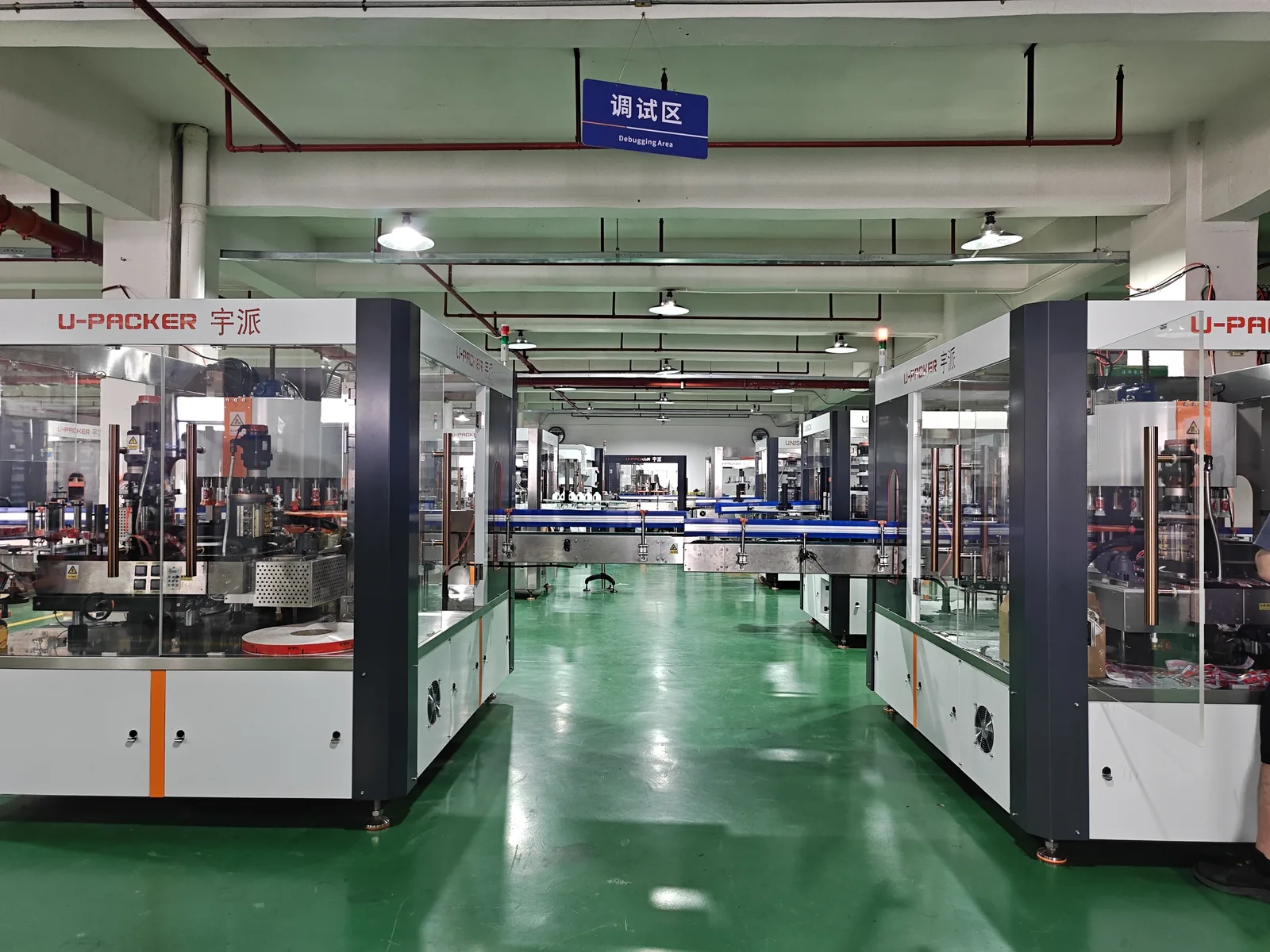
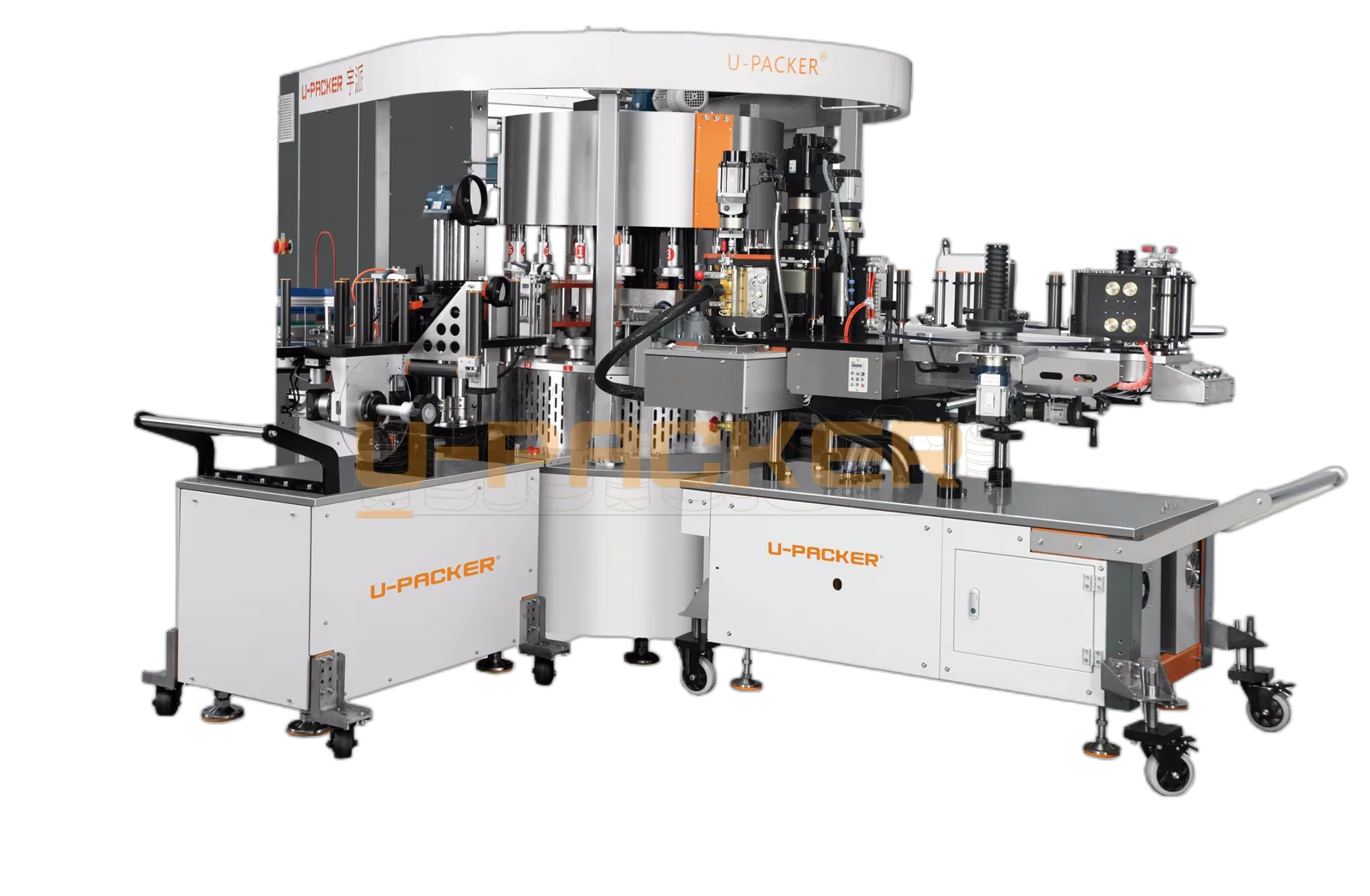
A labeling machine for wine bottles is an automatic labeler that applies the front, back and neck labels of a wine bottle - typically self-adhesive die-cut labels pressed onto glass - or a full wrap-around film band, in one pass at line speed. On U-Packer rotary machines, the self-adhesive class runs 12,000-18,000 bottles per hour at ±1mm placement on Bordeaux and Burgundy glass shapes, with multi-label configurations applying front, back and neck labels in a single rotation; wrap-around hot melt lines run to 58,000 bph for high-volume brands. The wine-specific challenges are glass handling - bottles are heavy, slippery and vary slightly as returnable stock cycles - neck-label registration on a tapering surface, and artwork placement where a few millimeters of drift moves the label off the mold seam line. Machines are sized one class above the filler, format parts are quoted per bottle shape, and quotations are validated by running the winery's actual bottles before contract.
What a winery actually labels
Estate and boutique wineries bottle in batches - a few thousand bottles of each cuvée, several cuvées a season - on 750 ml Bordeaux or Burgundy glass with front, back and sometimes neck labels. Volume per SKU is small, but label quality is the brand: placement must hold ±1mm against the bottle mold seam, and changeover between cuvées must be a format-and-roll change, not a re-engineering session. The standard wine bottle shapes cover most estates' ranges.
Regional producers and cooperatives run 6,000-12,000 bph lines through bottling season, mixing still and sparkling formats; for them the machine decision rides on station count - front+back in one pass - and on holding speed with full glass bottles in continuous infeed.
Contract bottlers change bottle shapes and artwork weekly and run other beverages between wine campaigns; they need per-SKU recipe recall (electronic cam machines store parameter templates per bottle) and fast format swaps measured in minutes.
Self-adhesive or wrap-around film for wine?
| Factor | Self-adhesive (die-cut) | Wrap-around (hot melt film) |
|---|---|---|
| Label set | Front + back + neck, any shape including contours | One full-body band |
| Premium shelf look | The classic wine presentation - textured papers, embossing-friendly | 360° print, modern look |
| Material cost | Higher - die-cut on backing paper | Roll-fed film typically 30-50% less per printed area |
| Speed | 12,000-18,000 bph rotary class | Up to 58,000 bph modular |
| Glue system | None | Hot melt at label ends only |
| Best for | Most still wine brands, all premium tiers | High-volume brands, bag-in-box replacement bottles, PET wine |
The market default for still wine is self-adhesive: the front-back-neck set is the category's visual language, and die-cut labels carry the textured, embossed papers premium tiers demand. Wrap-around film earns its place when volume rises and material cost per bottle starts to matter - the crossover logic and material economics are worked through in the hot melt vs self-adhesive guide. Wineries wanting both use a dual-mode machine, with the two processes on one frame. The same platforms label the rest of a bottling plant’s range: cans, jars and sauce bottles.
Machines matched to wine lines
| Machine | Speed (bph) | Wine labels | Best for |
|---|---|---|---|
| Single-station rotary | 1,200 | Wrap-around film | Small estates starting automation, entry tier |
| Rotary self-adhesive labeler | 12,000-18,000 | Front + back + neck | The classic wine line class |
| Dual-mode modular platform | Up to 58,000 | Both processes | Producers running wine and other beverages |
| Round bottle carousel | Up to 36,000 | Wrap-around film | High-volume still wine and PET wine lines |
For most still-wine estates the self-adhesive rotary class is the answer - front, back and neck applied in one rotation with the bottle fixtures sized to the glass. Match it to filler output with 15-20% headroom using the labeling capacity calculator, and verify label dimensions against bottle curvature before printing artwork with the bottle label size checker.
Self-adhesive labeling on glass, running
Rotary self-adhesive labeler applying front and back labels to glass bottles (watch on YouTube):
Specify your inquiry
Send us your bottle specs for a matched machine and an itemized quotation: bottle drawings with diameter, height and shoulder shape for each glass format (750 ml, 375 ml, magnums), label artwork with the size and position of every label - front, back, neck - the label roll specification, target bottles per hour at season peak, and the destination market. U-Packer runs your bottles and labels on the proposed machine before contract, so neck-label registration on your glass is proven, not assumed. Machines are built in the Guangzhou labeling machine factory.
Frequently asked questions
How do you choose a labeling machine for wine bottles?
Start from the label set, then the glass, then the speed. Front-back-neck label sets point to a self-adhesive rotary - the wine category's standard process - with bottle fixtures sized to your glass; full-body film labels point to wrap-around hot melt. Verify placement against the bottle mold seam (±1mm is the benchmark), size the machine one class above the filler with 15-20% headroom, and require a pre-contract run on your actual bottles - returnable glass varies slightly, and the machine must hold registration across that variation.
Can one machine apply front, back and neck labels on wine bottles?
Yes. Multi-label rotary configurations apply the front, back and neck label in a single bottle rotation, with each label fed from its own roll and registered independently - the neck label on its tapering surface included. The configuration is quoted per glass format, which is why bottle drawings and label positions belong in the RFQ; electronic cam machines additionally store the per-cuvée setup as a recipe, making seasonal changeovers a recall rather than a re-setup.
Do wineries use wrap-around labels?
Some do - high-volume still wine brands, PET wine bottles and bag-in-box replacement bottles, where a 360° film band at up to 36,000-58,000 bph cuts material cost 30-50% per printed area versus die-cut sets. Most still wine keeps self-adhesive for its front-back-neck presentation and textured premium papers. Producers running both use a dual-mode modular machine with the two processes on one frame.
Does a wine labeling machine handle different bottle shapes?
Yes, through format changes: bottle fixtures, guides and label rolls swap per shape - Bordeaux to Burgundy to 375 ml - in a changeover measured in minutes. Send drawings for every glass format in the cellar range so all format sets are quoted at once; electronic cam models store each cuvée's parameters so repeat changeovers are one recall.
How much does a wine bottle labeling machine cost?
Quoted per configuration: the self-adhesive rotary class covering 12,000-18,000 bph scales with station count and glass fixtures; dedicated rotary machines start around USD 50,000 and modular dual-process lines around USD 100,000 as market orientation. Over the machine's life, the label stock decision - die-cut versus roll-fed film - usually moves more money than the machine class; the price guide shows how to read an itemized quotation.