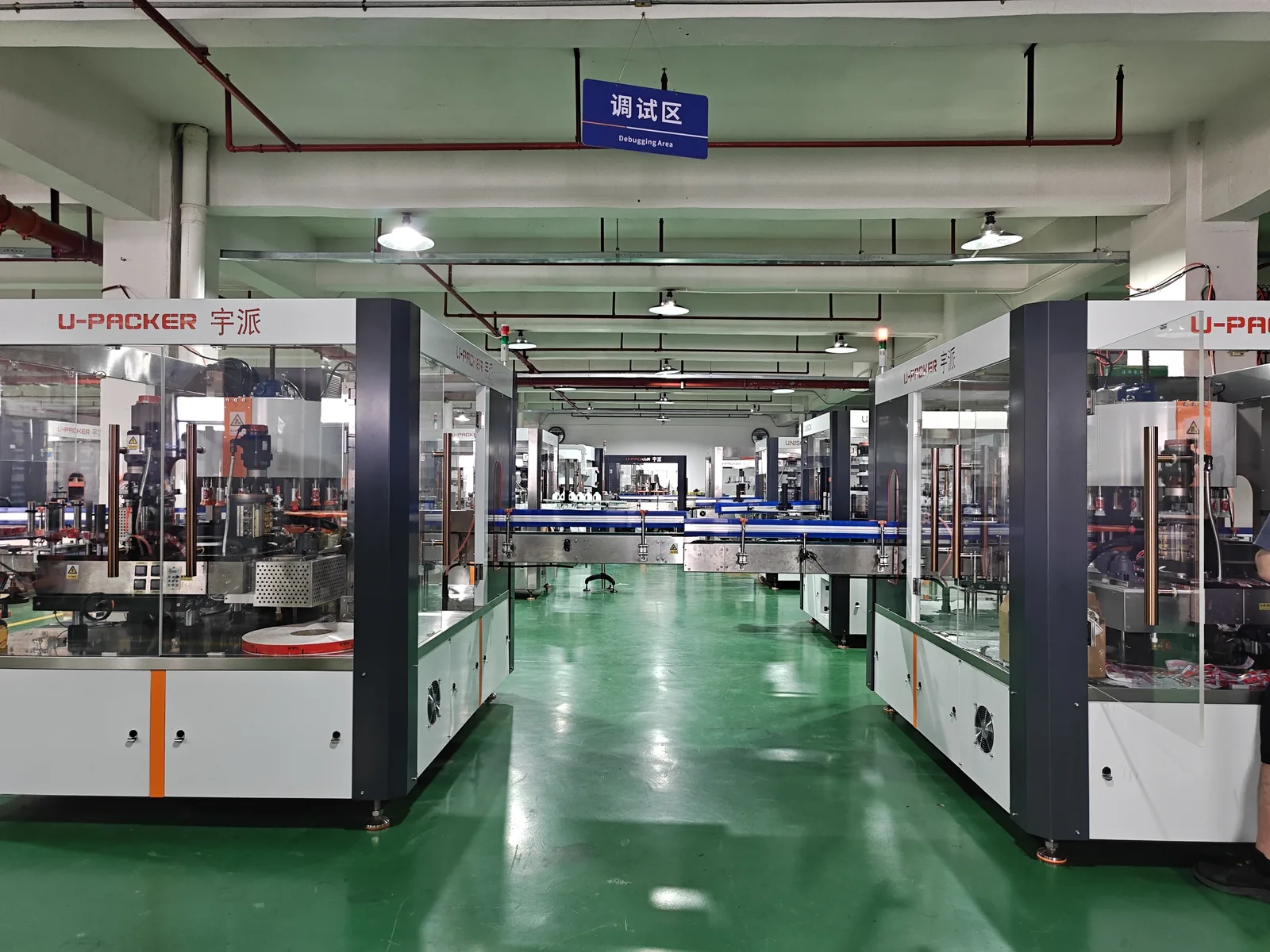
A jar labeling machine is an automatic labeler built to apply labels to round glass jars - jam jars, honey jars, sauce jars and spreads - where the container is squat and wide rather than tall, with typical food-jar diameters from about 40 mm to over 100 mm. Two processes cover the category: self-adhesive labeling, which presses die-cut front, back or full-body labels onto the glass and dominates artisan and premium food jars; and wrap-around hot melt labeling, which winds a roll-fed film or paper band 360 degrees around the jar for volume lines. On U-Packer rotary machines both run at ±1mm placement accuracy, from a 1,200 bph single-station labeler for small-batch preserving to 58,000 bph modular lines for co-packers. What makes jars different from bottles is the format: wide, sometimes short containers need their own chucks and guides, so jar drawings - diameter, height, shoulder shape - belong in the RFQ, and every quotation is validated by running the packer's actual jars before contract.
Who labels jars, and what they need
Artisan preserve and honey producers run dozens of SKUs in seasonal batches - strawberry to chestnut honey, 30 g mini jars to 500 g family jars - on the same machine. Their priority is changeover: format parts and label rolls swapping in minutes, with per-recipe setup stored so seasonal relabeling is a recall, not a rebuild. Paper texture and front-label placement carry the brand, so self-adhesive is the default process; the container side of the category is documented in the fruit preserve and jam references.
Regional food brands run 3,000-8,000 bph lines with front-plus-back or single full-wrap body labels on jars of one or two formats, where cost per jar and placement consistency across shifts matter equally.
Private-label co-packers change jar shapes and artwork weekly across customers - jam, sauce, spreads - and need multi-label configurations (front/back/neck or lid tab) applied in one pass with recipe-driven changeover.
Self-adhesive or wrap-around bands for jars?
| Factor | Self-adhesive (die-cut) | Wrap-around (hot melt band) |
|---|---|---|
| Typical jar use | Front/back labels, lid and neck tabs, premium papers | Full-body band on volume jars |
| Label shapes | Any contour, oval and arched labels included | Rectangular band, 360° print |
| Material cost | Higher - die-cut on backing paper | Roll-fed stock typically 30-50% less per printed area |
| Speed | 12,000-18,000 bph rotary class | Up to 58,000 bph modular platforms |
| Changeover | Roll and format change, minutes | Roll and format change, minutes |
| Best for | Artisan and premium jars, many SKUs | Volume SKUs, cost-per-jar focus |
The two processes compared in full - maintenance, energy and the material economics - are in the hot melt vs self-adhesive labeling machine guide. Co-packers serving both worlds run dual-mode modular machines with the two processes on one frame. The same rotary platforms cover the rest of the food and beverage range: cans, wine bottles and sauce bottles.
Machines matched to jar lines
| Machine | Speed (bph) | Jar labels | Best for |
|---|---|---|---|
| Single-station rotary | 1,200 | Wrap-around band | Small-batch preserving lines, replacing hand labeling |
| Electronic cam rotary | 4,000-7,200 | Wrap-around band | Seasonal SKU changes, per-recipe recall |
| Rotary self-adhesive labeler | 12,000-18,000 | Front + back + lid tab | Artisan and premium jar brands, multi-label sets |
| Dual-mode modular platform | Up to 58,000 | Both processes | Co-packers mixing jar types and label styles |
Jars' wide bodies raise one practical check: label length around the body on wrap-around lines, and label width against the label face curvature on self-adhesive lines. Both are verified before artwork printing with the bottle label size checker, and the machine class is matched to filler output with the labeling capacity calculator.
Multi-label jar labeling, running
Three-station self-adhesive modular machine applying multiple labels per container (watch on YouTube):
Specify your inquiry
Send us your jar specs for a matched machine and an itemized quotation: jar drawings with diameter, height and shoulder shape for every format (30 g minis to 500 g and larger), label artwork with the size and position of each label, label roll specification for self-adhesive or label length and overlap for wrap-around, target jars per hour, and the destination market. U-Packer runs your jars and labels on the proposed machine before contract; machines are built in the Guangzhou labeling machine factory with a 30-day standard lead time.
Frequently asked questions
What is a jar labeling machine?
An automatic labeler configured for round glass jars - squat, wide containers from roughly 40 to 100+ mm diameter. It applies self-adhesive die-cut labels (front, back, lid tab) or a 360-degree wrap-around band at ±1mm accuracy, from 1,200 bph single-station machines to 58,000 bph modular lines. The jar-specific part is format handling: chucks and guides sized to the jar, quoted per format and proven on your jars before contract.
Can one machine label jam jars, honey jars and sauce jars?
Yes, through format changes: fixtures and guides swap per jar diameter and height in minutes, and label rolls change with the artwork. Electronic cam machines store each recipe - jam 375 g, honey 500 g, sauce 250 ml - so repeat changeovers are a recall rather than a re-setup. Send drawings for every jar format so all format sets are quoted at once.
Self-adhesive labels or wrap-around bands on jars?
Self-adhesive for artisan and premium jars: any label shape, textured papers, front-back-lid sets in one pass. Wrap-around bands for volume SKUs: roll-fed stock typically costs 30-50% less per printed area, with glue only at the band's two ends. The full comparison - including maintenance and energy - is in the hot melt vs self-adhesive guide.
How fast can a jar labeling machine run?
Single-station rotary 1,200 bph; electronic and mechanical cam rotaries 4,000-7,200 bph; the self-adhesive rotary class 12,000-18,000 bph; modular platforms up to 58,000 bph. Jars' wide, short bodies make stable infeed the real speed constraint - size the machine one class above your filler so the labeler never starves the line.
How much does a jar labeling machine cost?
Quoted per configuration: dedicated rotary machines start around USD 50,000 and modular multi-process lines around USD 100,000 as market orientation, with jar format count and station count moving the number. Over the machine's life the label stock decision usually matters more than the machine class - the 30-50% per-area gap between die-cut and roll-fed material compounds across millions of jars. The price guide explains what an itemized quotation contains.