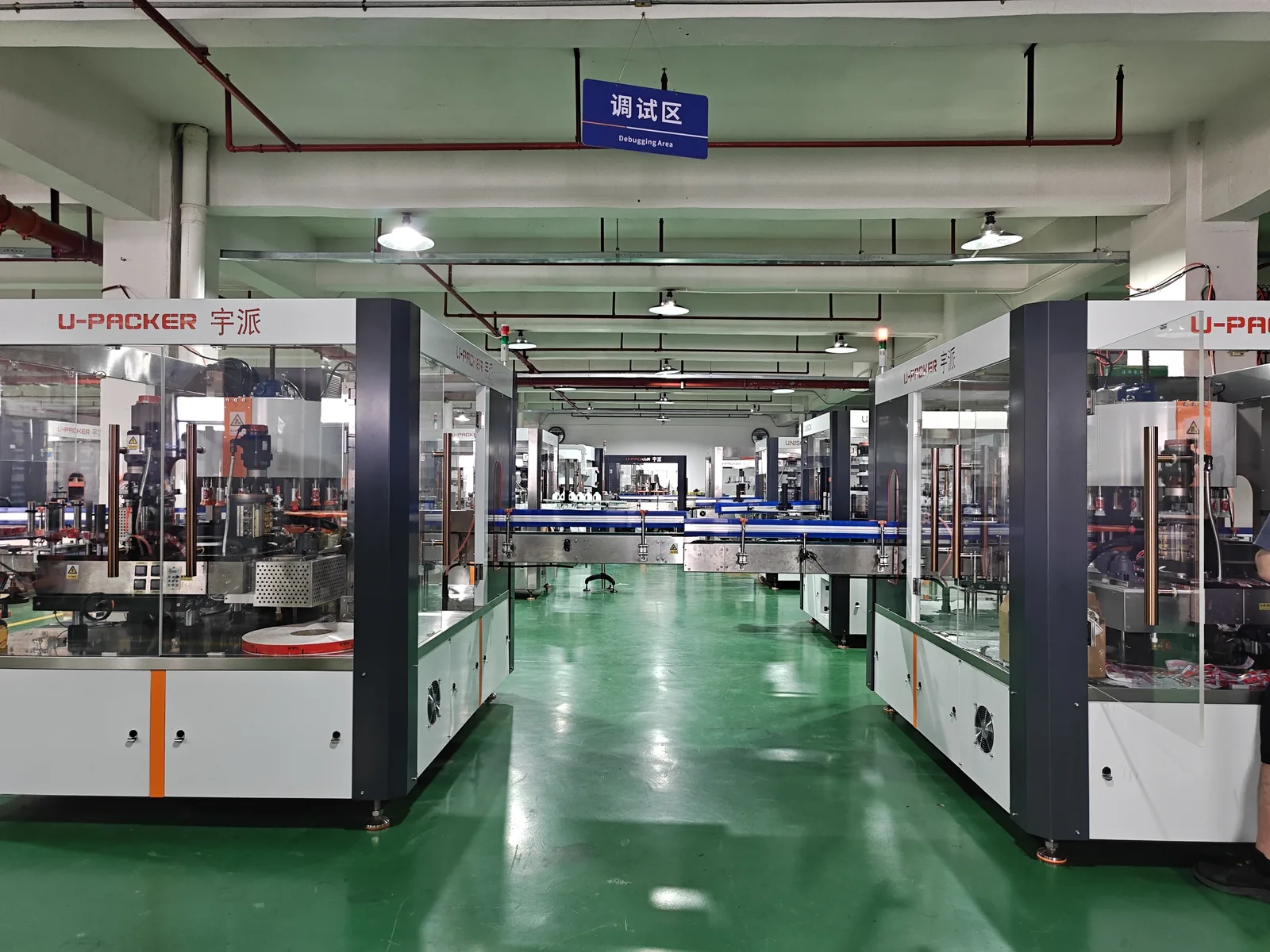
An OEM labeling machine is a proven machine platform - here, U-Packer's rotary hot melt and self-adhesive labelers from 1,200 to 58,000 bph - built and rebranded for another company: your nameplates, your colors, your documentation, your market. A custom labeling machine is engineered for a job no catalog machine covers exactly: an unusual container, a non-standard label layout, an adaptation to an existing line. U-Packer runs both programs from its own factory in Guangzhou, where the engineering, machining, assembly and testing stay in-house - which is the precondition for either program. A custom labeling machine manufacturer that builds its own machines can carry your containers through the same sample-run, FAT and documentation discipline as its own brand; a reseller cannot. Every program machine is individually configured and tested, which is also why neither program has a minimum order quantity beyond the machine itself.
What each program covers
| OEM program | Custom build | |
|---|---|---|
| Base | Proven U-Packer platform, unchanged inside | Engineered from your requirement |
| Typical partner | Distributors, system integrators, line builders | End users with unusual containers or lines |
| What changes | Nameplates, colors, documentation, packaging | Bottle handling, label stations, line interfaces |
| What stays | Engineering, assembly, testing, spares compatibility | The rotary platform family and factory QC |
| Lead time | Standard 30 days plus branding | Quoted per project after engineering review |
OEM in practice. A distributor selling complete packaging lines sources the labeler as part of the project: the machine arrives under the distributor's brand, with U-Packer's factory test report and spares documentation behind it. The distributor keeps the customer relationship; the machines keep their engineering. Rebranding covers nameplates, control-panel language and colors, manuals and crating - agreed per program, in writing.
Custom in practice. The request usually starts with a container drawing: a squat oval bottle, a wide jar, a 20 L drum, a bottle with a label position that standard stations do not reach. Engineering reviews it against the platform family - fixtures, stations, glue or peel units - and answers with a configuration: standard machine, custom format parts, or a layout that mounts two processes on one frame. The boundary of custom work is the boundary of the container: send the drawings and the machine answers.
The five-step process
1. RFQ with real objects. Bottle drawings with dimensions, label artwork with positions, target speed, destination market. The more real the input, the shorter the engineering loop.
2. Engineering review. The factory reviews the container and label against the platform family and returns a configuration, a price and a lead time - with anything genuinely non-standard flagged at this stage, not at commissioning.
3. Sample run before contract. Your bottles and labels run on the proposed machine class at the quoting stage; U-Packer supplies the video, so the placement you are buying is demonstrated before it is paid for.
4. Build and FAT. Standard production lead time is 30 days from confirmed configuration. Before the balance payment, the machine passes a factory acceptance test on your containers at rated speed - witnessed in person, by video or by your inspection agency - and the passing parameter set travels with the machine.
5. Delivery and spares. Export crating, destination-market configuration (CE-compliant builds for Europe, voltage and conventions elsewhere), and a spares package with pricing agreed at purchase - because OEM and custom machines stay supported exactly like the factory's own brand. The company behind these programs is introduced on the China labeling machine manufacturer & factory page.
Wholesale and distribution cooperation
OEM programs overlap with wholesale and dealership cooperation: a distributor carrying a territory, a system integrator specifying labelers into turnkey lines, a packaging machinery brand completing its range. All follow the same rule as every machine sale - one engineered configuration, one tested machine, one responsible factory - with territory terms, spares stocking and support responsibilities written into the agreement. Machine pricing across the range follows configuration, not brand: the labeling machine price guide explains the bands and how an itemized quotation is built.
Frequently asked questions
What is an OEM labeling machine?
A proven labeling machine platform built under another company's brand: your nameplates, colors, documentation and market identity on a machine whose engineering, assembly and testing remain in the manufacturer's factory. For distributors and system integrators it means a labeler line without building one; for end users it changes nothing about the machine inside. U-Packer runs OEM programs on its rotary hot melt and self-adhesive platforms from 1,200 to 58,000 bph, with spares compatibility preserved across the brand.
What does a custom labeling machine manufacturer do?
It engineers machines for jobs catalog machines do not cover exactly: unusual containers - squat ovals, wide jars, drums - non-standard label layouts, and adaptations to existing lines. The work starts from your bottle drawings and label artwork, passes an engineering review that returns a configuration, a price and a lead time, and ends with a factory acceptance test on your containers. U-Packer does this from its own Guangzhou factory, on the same rotary platform family and the same QC discipline as its own brand.
Is there a minimum order for OEM or custom machines?
No - beyond the machine itself. Each machine is individually configured, built and tested, so the economics do not change with quantity the way consumer goods do. A one-machine custom build and a ten-machine OEM program both run the same five steps: RFQ, engineering review, sample run, build and FAT, delivery with spares.
How long do OEM and custom builds take?
Standard production is 30 days from confirmed configuration plus sea freight; branding work on OEM machines is agreed within the program and does not usually extend the build. Custom machines are quoted per project: if the requirement needs new format parts, lead time scales with those parts and is stated in the quotation - before contract, not after.
Who services an OEM machine - the brand or the factory?
That is written into each program. The default: the factory supports the machine exactly as its own brand - spares, documentation, remote diagnostics and the warranty in the contract - while the brand owns the customer relationship. Spares compatibility is preserved across rebranding precisely so that year-five support does not depend on who painted the panel.
How is an OEM or custom machine priced?
By configuration, like every labeling machine: stations, speed class, format parts and destination-market requirements drive the number, with OEM branding agreed as a program term. Dedicated rotary machines start around USD 50,000 and modular platforms around USD 100,000 as market orientation - the price guide shows how to read the itemized quotation both programs return.